

IC 4710
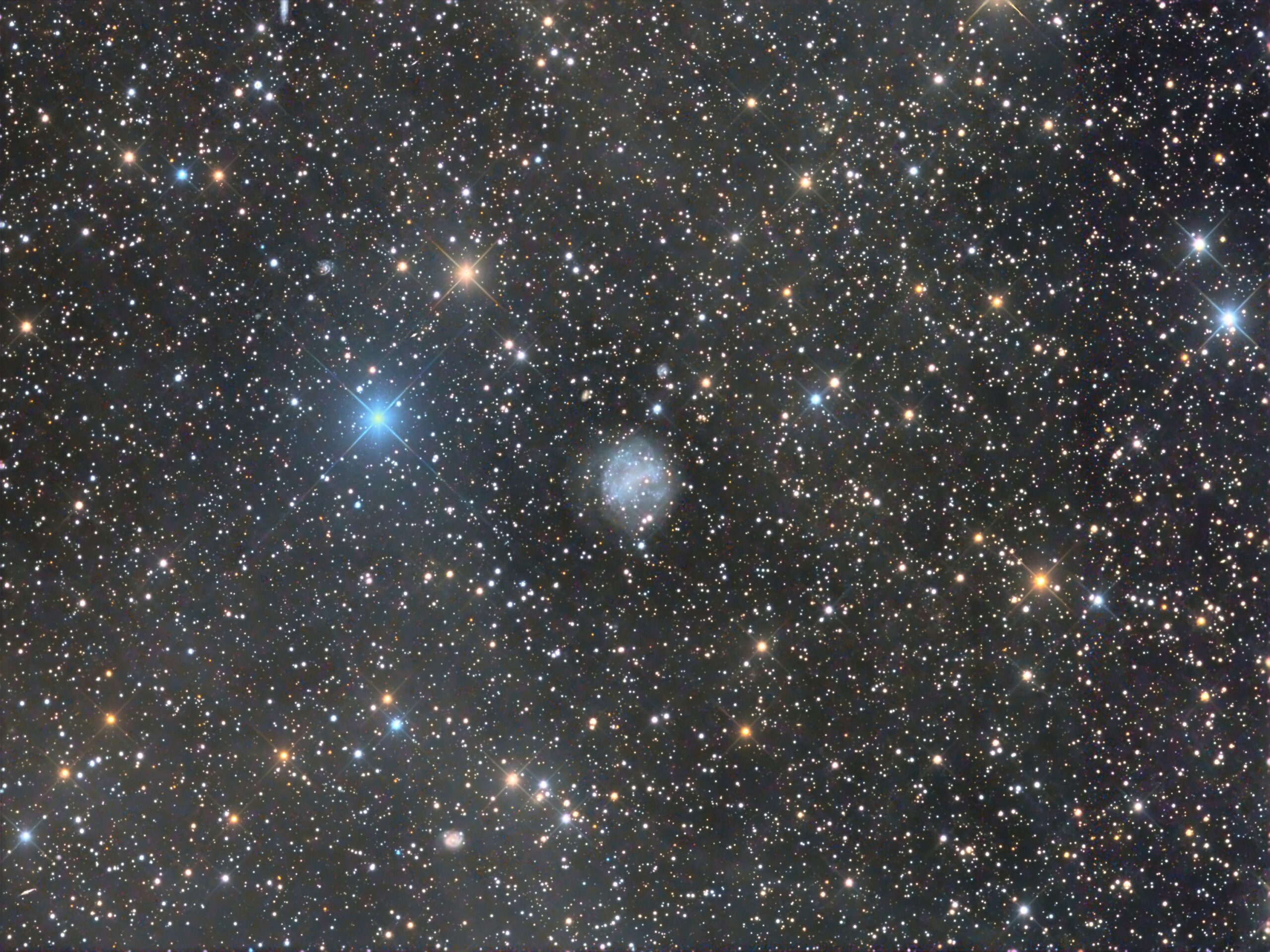
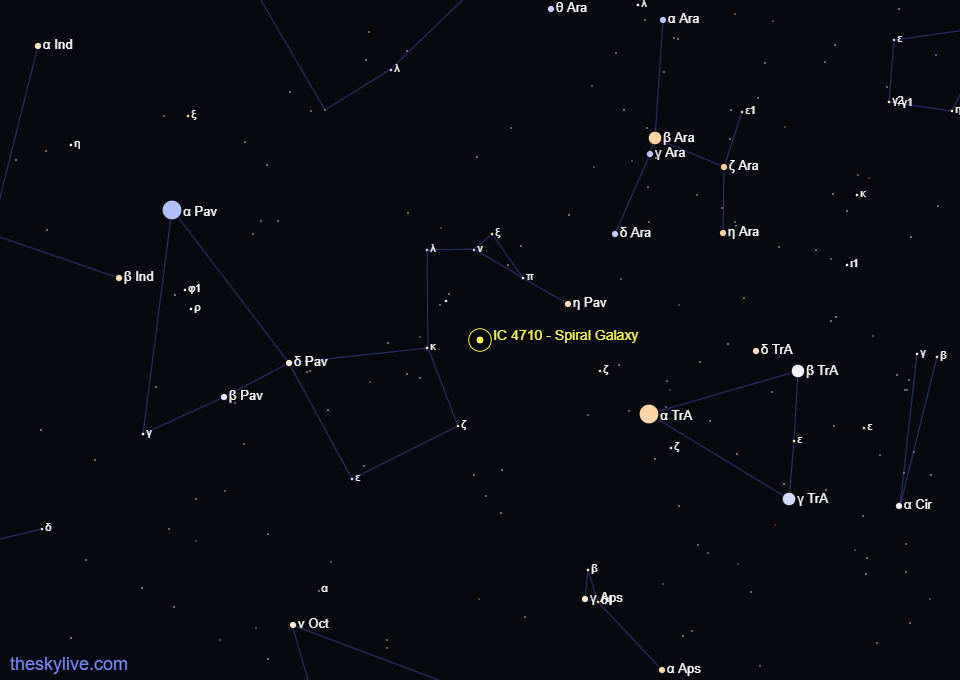
In May 2015, I spent several unforgettable nights under the magnificent southern skies of the Tivoli astrofarm in Namibia. During that stay, I used the equipment of the Stella Observatory to capture a number of deep-sky objects that are either difficult or impossible to observe from Europe. One of these targets was the beautiful spiral galaxy IC 4710, located in the constellation Pavo. The combination of exceptionally dark skies, excellent seeing, and professional equipment provided ideal conditions for recording the galaxy’s delicate spiral structure and the rich background of distant galaxies.
IC 4710 lies at a distance of approximately 85 million light-years and is classified as an intermediate barred spiral galaxy. Although considerably less well known than the famous Messier galaxies, it is a rewarding target for deep astrophotography because of its nearly face-on orientation, which allows its graceful spiral pattern to be observed in remarkable detail. The bright central bulge is surrounded by multiple loosely wound spiral arms that contain numerous regions of ongoing star formation.
The galaxy exhibits a striking network of dark dust lanes that weave through its spiral arms. These dust clouds absorb the light of stars behind them while simultaneously providing the raw material from which new generations of stars continue to form. Embedded within the arms are numerous H II regions, glowing clouds of ionized hydrogen where recently formed massive stars illuminate the surrounding gas. These star-forming complexes give the spiral arms their patchy appearance and reveal that IC 4710 remains an active spiral galaxy.
Like many spiral galaxies, IC 4710 is surrounded by an extended halo of older stars that gradually fades into the darkness of intergalactic space. Deep images also reveal numerous faint background galaxies scattered throughout the field of view. These distant galaxies, many hundreds of millions or even billions of light-years away, provide a striking sense of the enormous depth captured in a single astronomical image.
From a scientific perspective, IC 4710 represents a typical intermediate spiral galaxy whose structure is shaped by the interplay between gravity, gas dynamics, and star formation. Studying galaxies like IC 4710 helps astronomers better understand how spiral arms evolve, how stars continue to form over billions of years, and how galaxies gradually transform throughout cosmic history. Because the galaxy is viewed at a favorable inclination, it serves as an excellent object for investigating the distribution of dust, gas, and stellar populations across a spiral disk.
The image obtained during my stay at the Tivoli Astrofarm beautifully captures the galaxy’s delicate spiral arms, intricate dust lanes, and numerous blue star-forming regions against the pristine southern sky. It also showcases the exceptional quality of the Stella Observatory and the outstanding observing conditions of Namibia, which remain among the finest in the world for astronomical imaging. This photograph is one of my favorite southern-galaxy images from the 2015 expedition and serves as a reminder of the extraordinary beauty that can be revealed under truly dark skies.
Data calibration and registration and the final processing was done with PixInsight. The result was as follows:
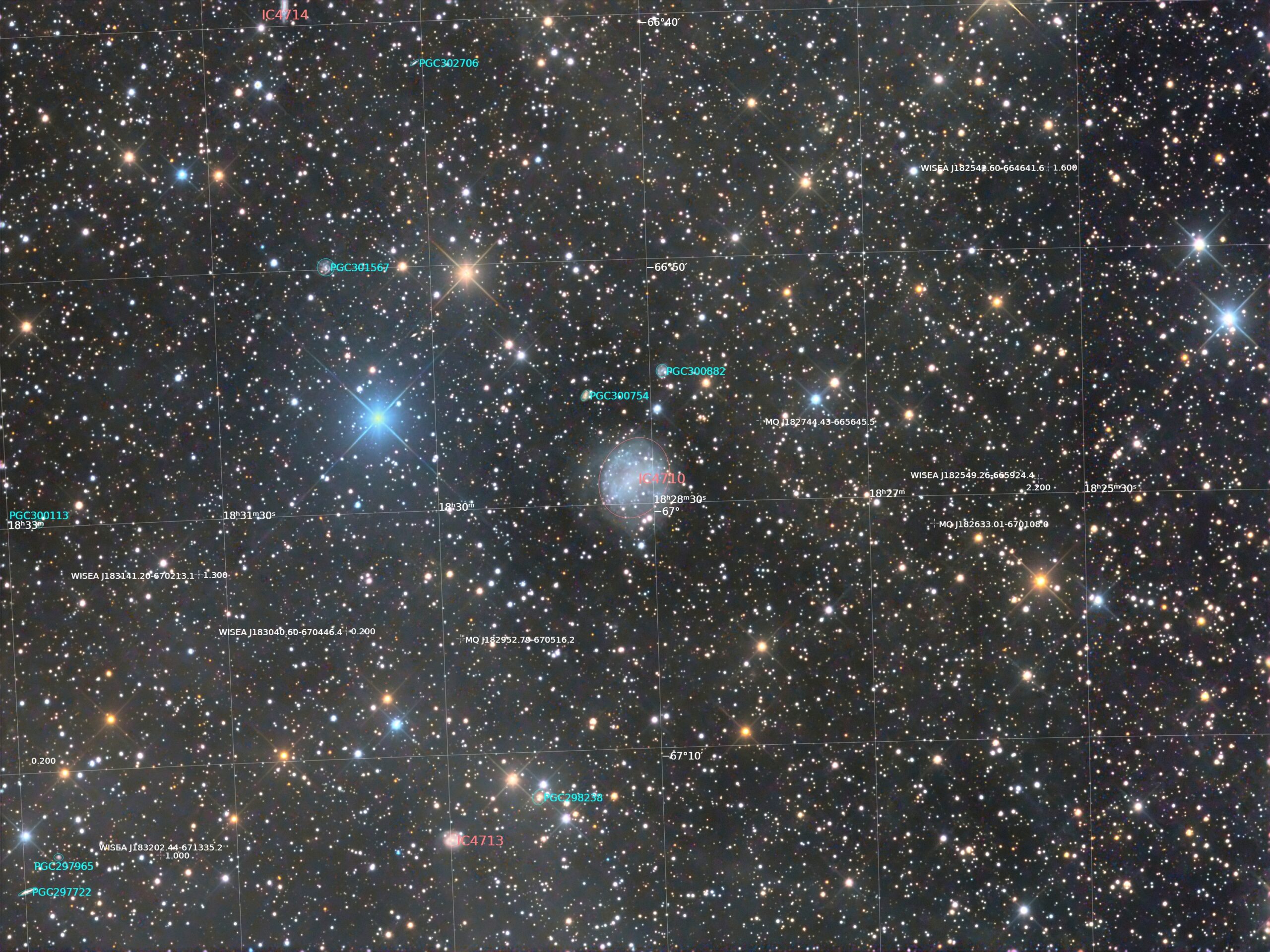
In the image you can also find some quasars. The most distant of them is:
WISEA J182549.26-665924.4 with a redshift of 2.20 and an apparent magv of 19.5 (SDSS DR17).
The images were taken with the following equipment:
- Location: Tivoli, Namibia
- Telescope: 12“ ASA Astrograph
- Focal length [mm]: 1076
- Focal ratio: 3.6
- Mount: ASA DDM 85
- Camera: FLI Microline ML8300
- Filter: L:R:G:B
- Exposure time [min]: 345:60:60:60
- Resolution: 1.04″/px



Leave a reply