

NGC 7252
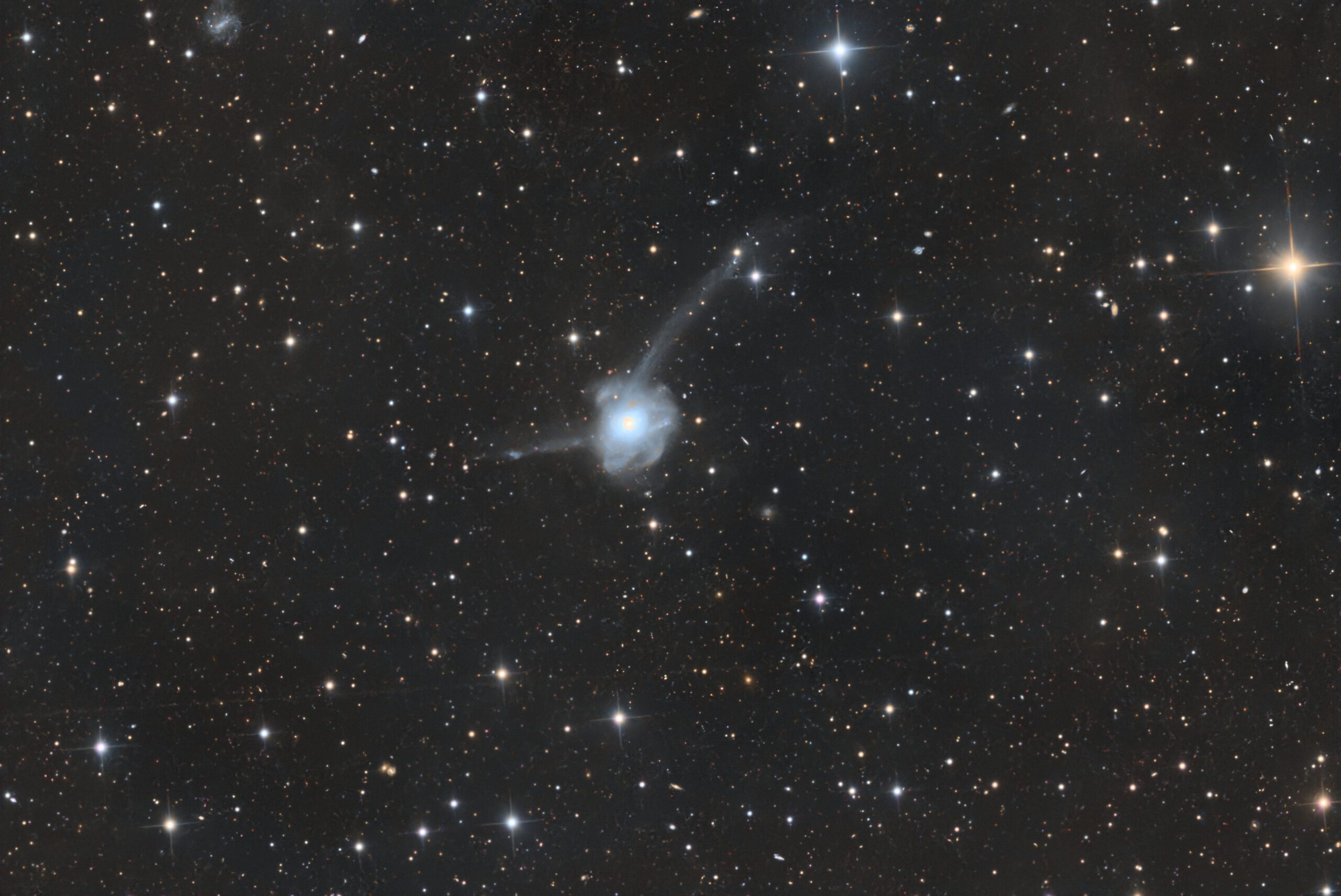
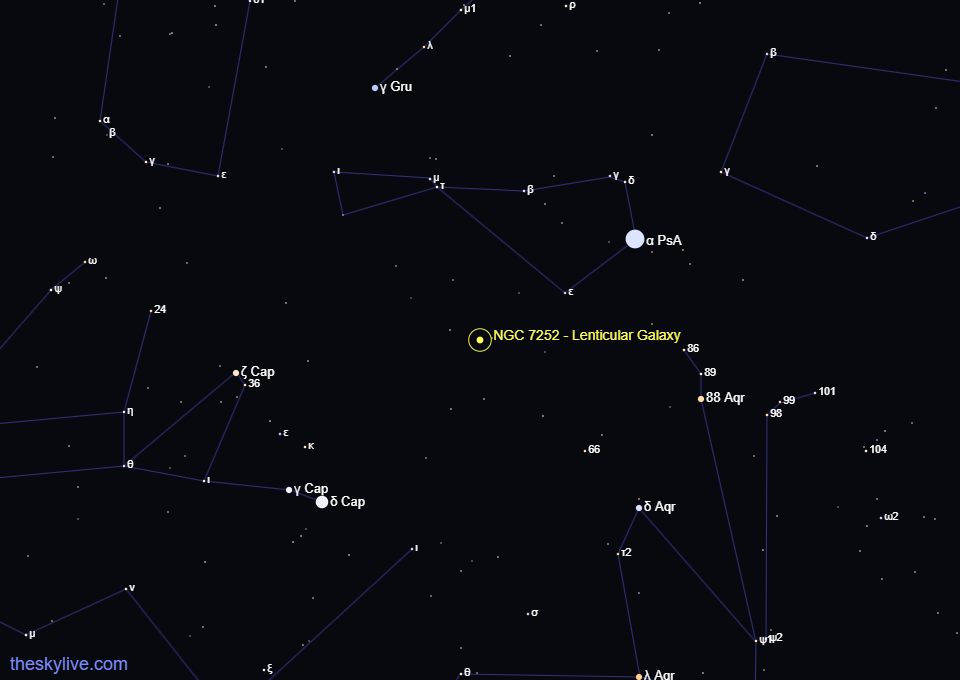
From time to time, I obtain datasets from remote observatories around the world. One of my favorite providers is Telescope Live, which operates telescopes at outstanding astronomical sites in Chile, Australia, and Spain. One of the datasets I received, acquired in 2023 with a telescope in Chile, featured the remarkable galaxy NGC 7252, located in the constellation Aquarius. The exceptional image quality and the pristine skies of the Atacama Desert allowed the faint outer structures of this extraordinary galaxy to be recorded in impressive detail.
NGC 7252 lies approximately 220 million light-years from Earth and is one of the finest known examples of a galactic merger in progress. Nicknamed the Atoms-for-Peace Galaxy, the name reflects its peculiar appearance, whose extended tidal tails reminded astronomers of the atomic symbol popularized during the „Atoms for Peace“ initiative of the 1950s. The galaxy represents the final stages of a collision between two large spiral galaxies that began several hundred million years ago.
The violent interaction has dramatically reshaped both galaxies. Their original spiral structures have largely disappeared, replaced by a disturbed central body surrounded by enormous tidal tails stretching hundreds of thousands of light-years into space. These spectacular streams of stars and gas were pulled outward by the immense gravitational forces generated during the collision and remain visible long after the initial encounter.
Despite the destruction caused by the merger, NGC 7252 also demonstrates how galaxy collisions can trigger the birth of new stars. Vast quantities of gas have been driven toward the galaxy’s center, producing an intense burst of star formation. Numerous young massive star clusters, sometimes referred to as super star clusters, have formed during this process. Many astronomers believe these compact clusters may eventually evolve into objects resembling the classical globular clusters found around mature galaxies.
Deep images also reveal faint shells, loops, and diffuse stellar streams surrounding the main galaxy. These delicate structures preserve the dynamical history of the merger and provide valuable clues for reconstructing the interaction. Numerical simulations have shown that the system is likely to evolve into a giant elliptical galaxy, illustrating one of the primary pathways by which massive galaxies grow over cosmic time.
NGC 7252 has therefore become one of the most important laboratories for studying galaxy evolution. It provides direct evidence that collisions and mergers play a fundamental role in shaping galaxies throughout the Universe. Observations across optical, infrared, radio, and X-ray wavelengths continue to reveal how gas, dust, stars, and dark matter interact during these dramatic events.
The Telescope Live dataset from 2023 beautifully captures the bright central remnant together with its delicate tidal tails and the wealth of faint background galaxies scattered across the field. Processing such high-quality data from a professional telescope under the exceptional skies of Chile made it possible to reveal subtle structures that are extremely challenging to record from light-polluted locations. The resulting image is a striking portrait of one of the most spectacular galactic mergers in the nearby Universe and an excellent example of the scientific value of remote-observatory data.
Data calibration and registration and the final processing was done with PixInsight. The result was as follows:
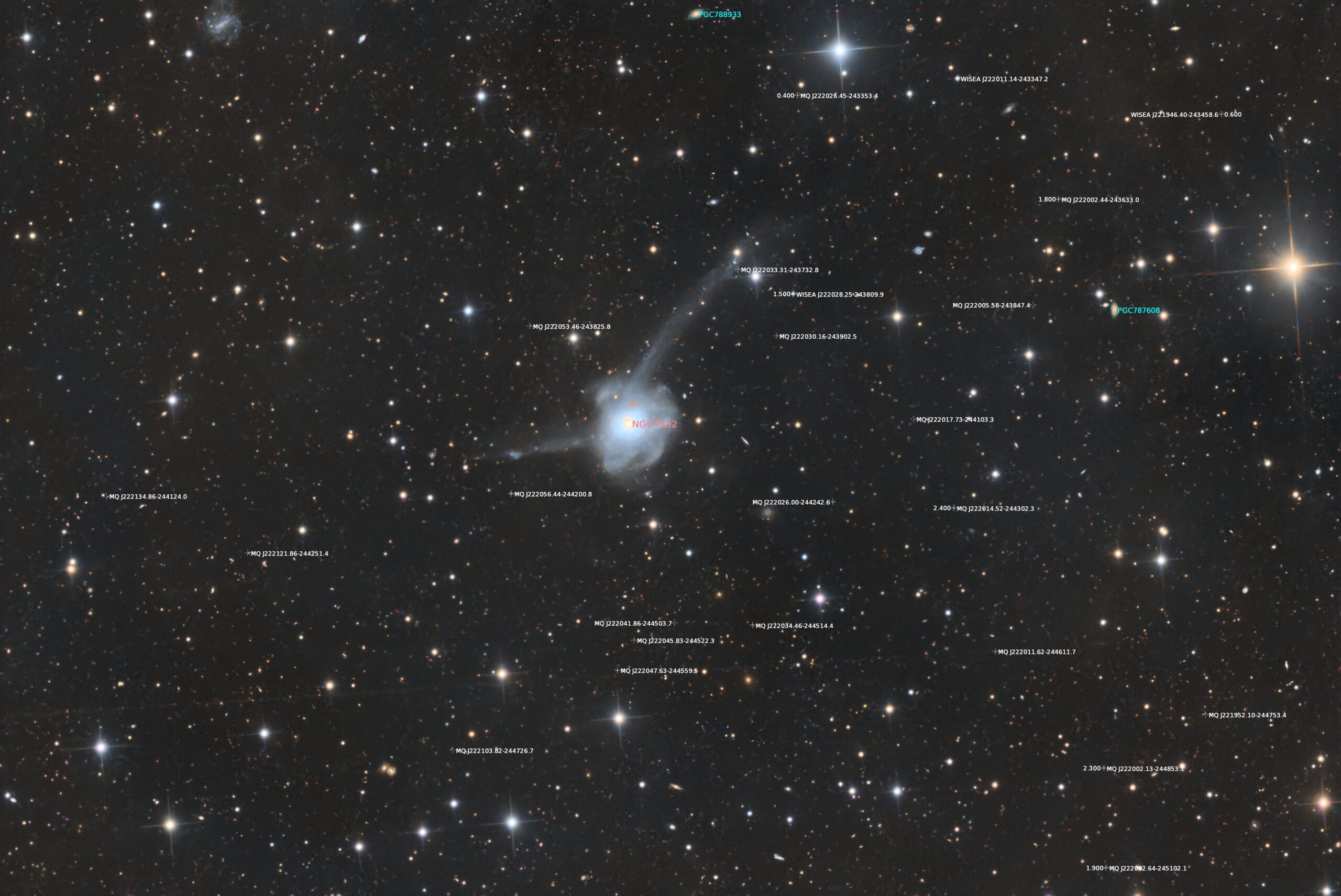
In the field were quiet a lot of quasars (see annotation). The two most distant of them are:
MQ J222014.52-244302.3 with a redshift of 2.4 and an apparent magB of 20.98 (2017,PASA,34,25).
MQ J222002.13-244853.1 with a redshift of 2.3 and an apparent magB of 20.74 (2017,PASA,34,25).
The faintest object in this image has an apparent magnitude of approx. 22.4 magB (2017,PASA,34,25).
The images were taken with the following equipment (Telescope Live CHI-1):
- Date: 2023
- Location: El Sauce Observatory, Chile
- Telescope/Lense: Planwave CDK24
- Focal length [mm]: 3900
- Focal ratio: 6.5
- Mount: Mathis MI-1000/1250
- Camera: QHY 600M
- Filter: LRGB
- Exposure time [min]: 160:150:160:150
- Resolution: 0.39″/px (bin 2)



Leave a reply