

Sh2-216 from remote
In 2022 I received an SHO dataset of Sh2‑216, Sh2‑217, Sh2‑219 and Sh2‑221 from Telescope Live in Spain, from which I produced both a bicolor and a full SHO image. This field is scientifically fascinating because it brings together two very different kinds of nebulae: Sh2‑216, an extremely old and nearby planetary nebula, and Sh2‑221, a supernova remnant, along with neighboring H II regions Sh2‑217 and Sh2‑219 that trace ongoing massive star formation in the outer Galaxy.
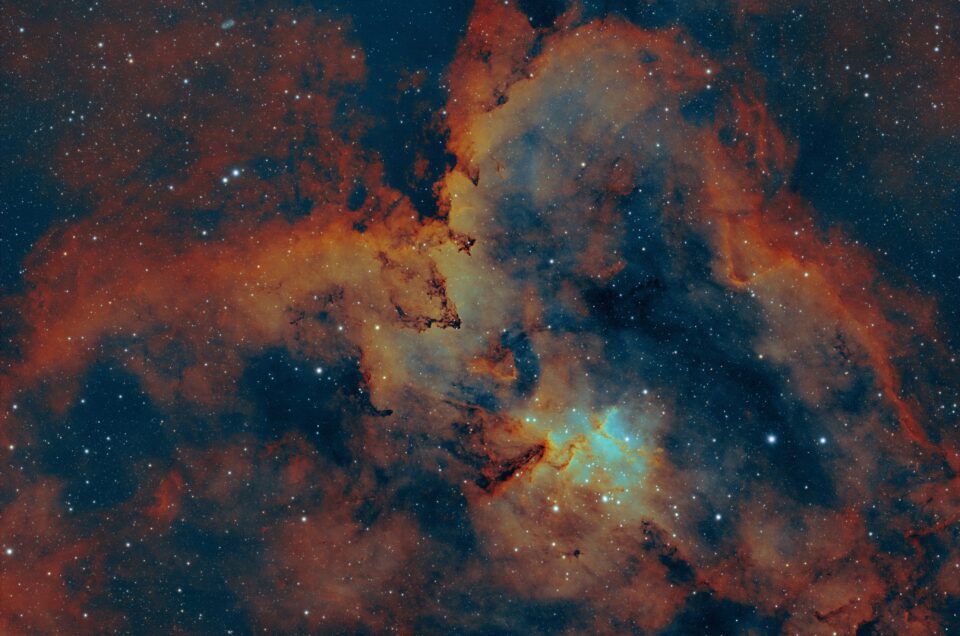
My SHO dataset, with separate S II, H‑alpha and O III channels, allows me to map all these different physical regimes in one image. In the full SHO rendering, S II is typically mapped to red, Ha to green, and O III to blue: this emphasizes differences in ionization state and excitation across the field.
The planetary nebula Sh2‑216 appears as a huge, diffuse Ha/S II bubble with sparse O III, reflecting its low surface brightness and advanced age. HB9’s supernova remnant reveals sharper, filamentary structures, often rich in S II and O III where shocks are strongest. The compact H II regions Sh2‑217 and Sh2‑219 show up as small but vivid emission patches embedded within the larger Galactic background, highlighting ongoing star formation.
My bicolor version—typically combining Ha and O III (HOO)—offers a different view. In HOO, Ha is often mapped to red and O III to green/blue, which yields a more “natural” look while still strongly enhancing emission structures. Sh2‑216’s vast Ha bubble dominates as a gentle reddish glow, with the faint O III showing subtle cyan highlights along parts of its rim. HB9’s shock‑heated gas appears more bluish‑green where O III is strong, setting its filaments apart from the softer Ha background. The H II regions become bright red knots with teal fringes, visually separating star‑formation zones from shock‑dominated areas.astroanarchy.blogspot+1
Sh2‑216 in Perseus is the closest known planetary nebula, only about 120–130 pc (≈390–420 light‑years) from Earth. Because it’s so near and very old (∼300,000–400,000 years), its shell has expanded to an apparent diameter of roughly 1.6–1.7 degrees – over three times the full Moon – but with extremely low surface brightness.
The central star, catalogued as LS V +46 21 or ALS 8032, is a hot DAO white dwarf of about 0.55 solar masses and a temperature near 95,000 K, responsible for ionizing the faint surrounding gas. Astrophotographers often map Hα, [O III] and [S II] to show that different ions occupy slightly different parts of the shell, revealing how the ancient planetary nebula interacts with the ambient interstellar medium.
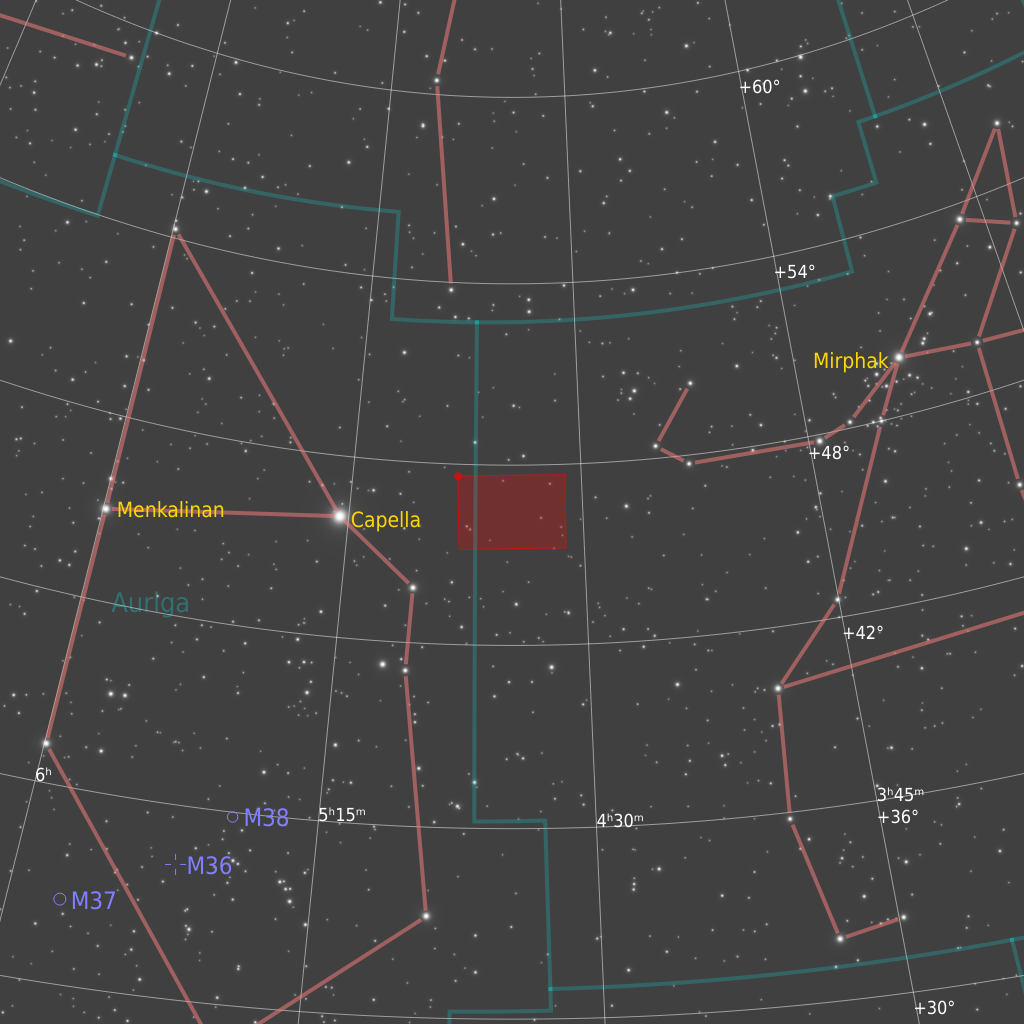
On the same wide field, Sh2‑221 (SNR G160.4+02.8, also called HB 9) is a large, very faint supernova remnant in Auriga, at a distance of about 2,600 light‑years. It appears as diffuse, filamentary red and blue arcs of emission, tracing shock‑heated gas from an ancient stellar explosion.
In terms of stellar evolution, Sh2‑221 is the “explosive” endpoint: a massive star’s core collapses and the outer layers are ejected, leaving a remnant shell and likely a neutron star at the centre. In the classic wide‑field images, Sh2‑216 (planetary nebula) and Sh2‑221 (supernova remnant) are shown side by side as “two ways to die” for stars of different masses.
Between Sh2‑216 and Sh2‑221 lies Sh2‑217, a diffuse H II region, and Sh2‑219, a compact bright H II nebula, both marking sites of ongoing star formation. Sh2‑219 is a small, bright hydrogen emission nebula – a stellar nursery where new stars are being born from collapsing gas. Sh2‑217 is a more extended, fainter glow of ionized hydrogen that likely belongs to the same complex and helps trace the larger cloud structure.
Together, Sh2‑217 and Sh2‑219 represent the opposite side of the stellar life cycle in this field: they are regions where stars are forming, not dying. The H II glow comes from young, hot O‑ and B‑type stars ionizing the surrounding gas, very much like in classic star‑forming regions, but here projected close to both a planetary nebula and a supernova remnant.
Data calibration and registration and the final processing was done with PixInsight. The result was as follows:
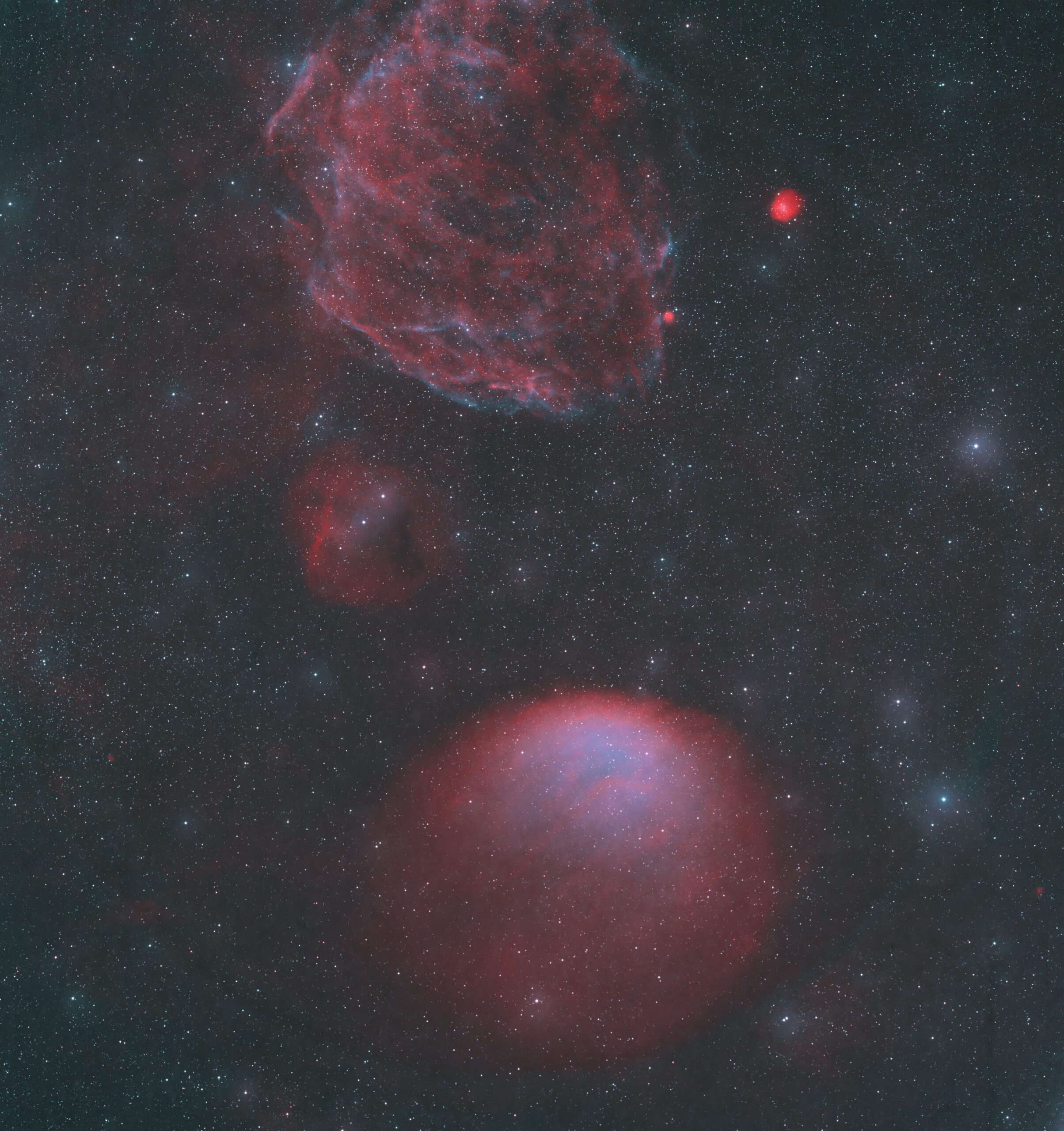
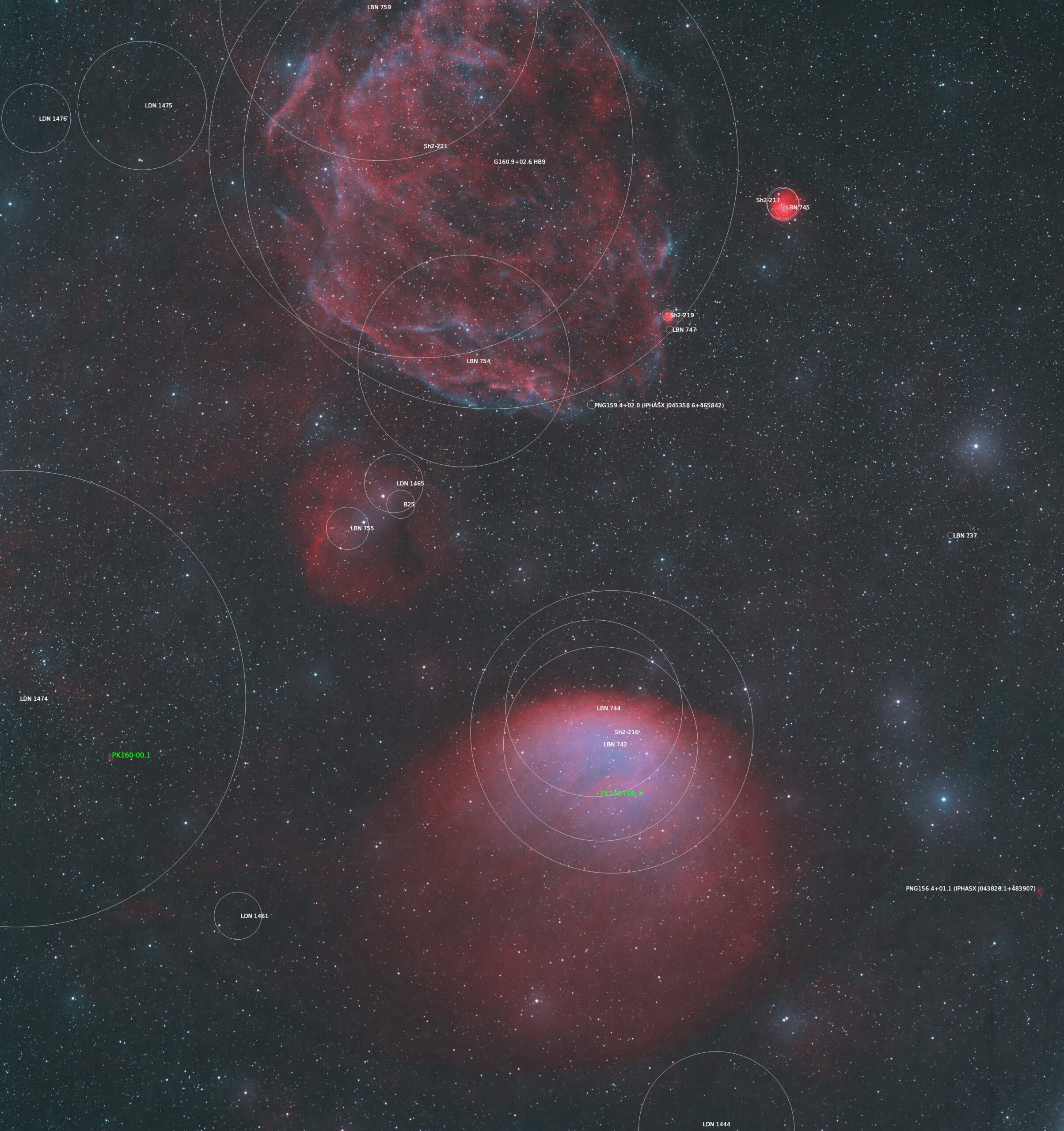
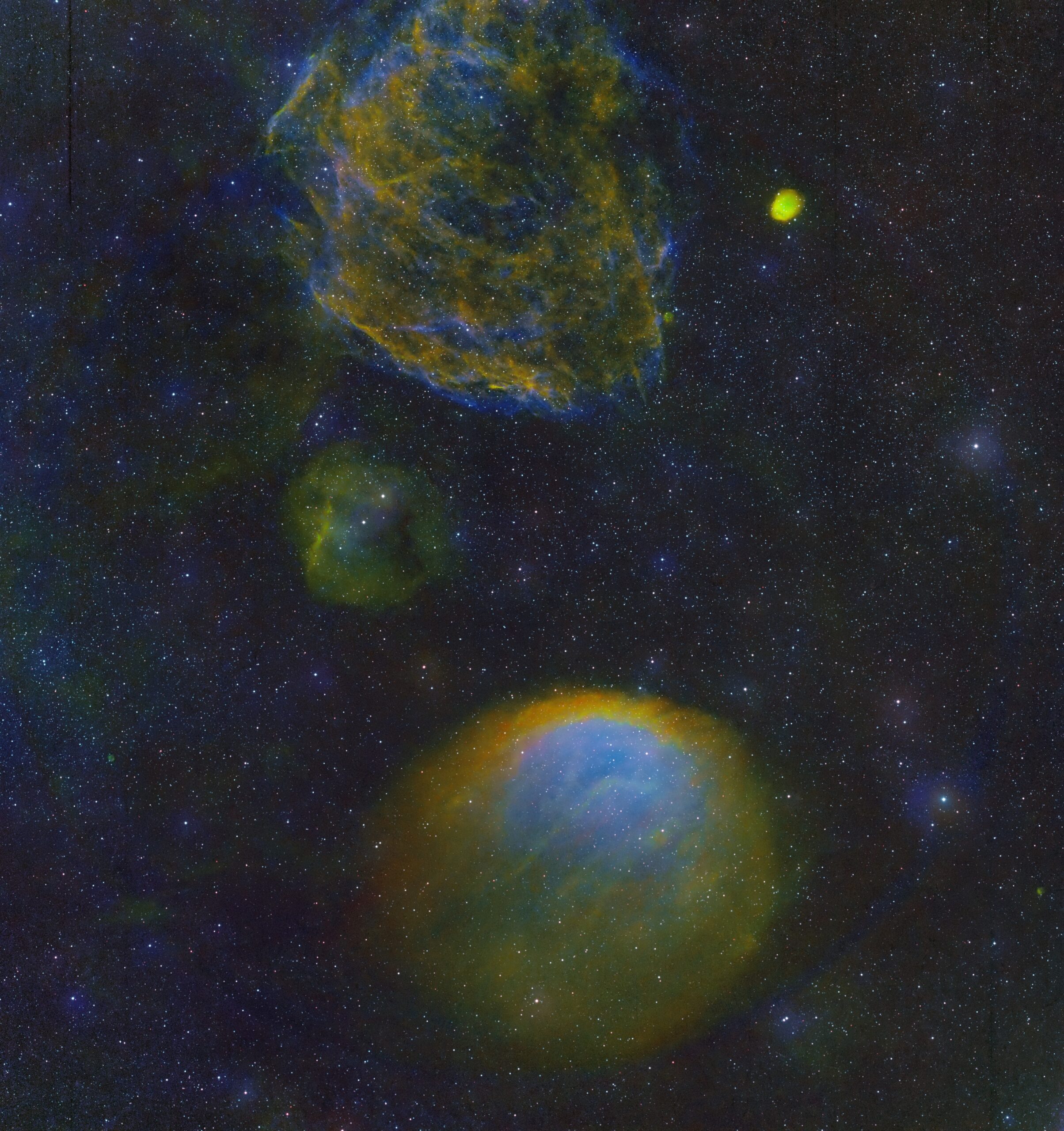
The images were taken with the following equipment (SPA-3 CCD, Telescope Live):
- Date: 2022-2023
- Location: IC Astronomy Observatory, Spain
- Telescope/Lense: Takahashi FSQ-106EDX4
- Focal length [mm]: 390
- Focal ratio: 3.6
- Mount: Paramunt MX+
- Camera: FLI Proline 16083
- Filter: Hα:[OIII]:[SII]
- Exposure time [min]: 260:260:260
- Resolution: 3.6″/px



Leave a reply