

NGC 1909 / IC 2118 Witch Head Nebula) from remote
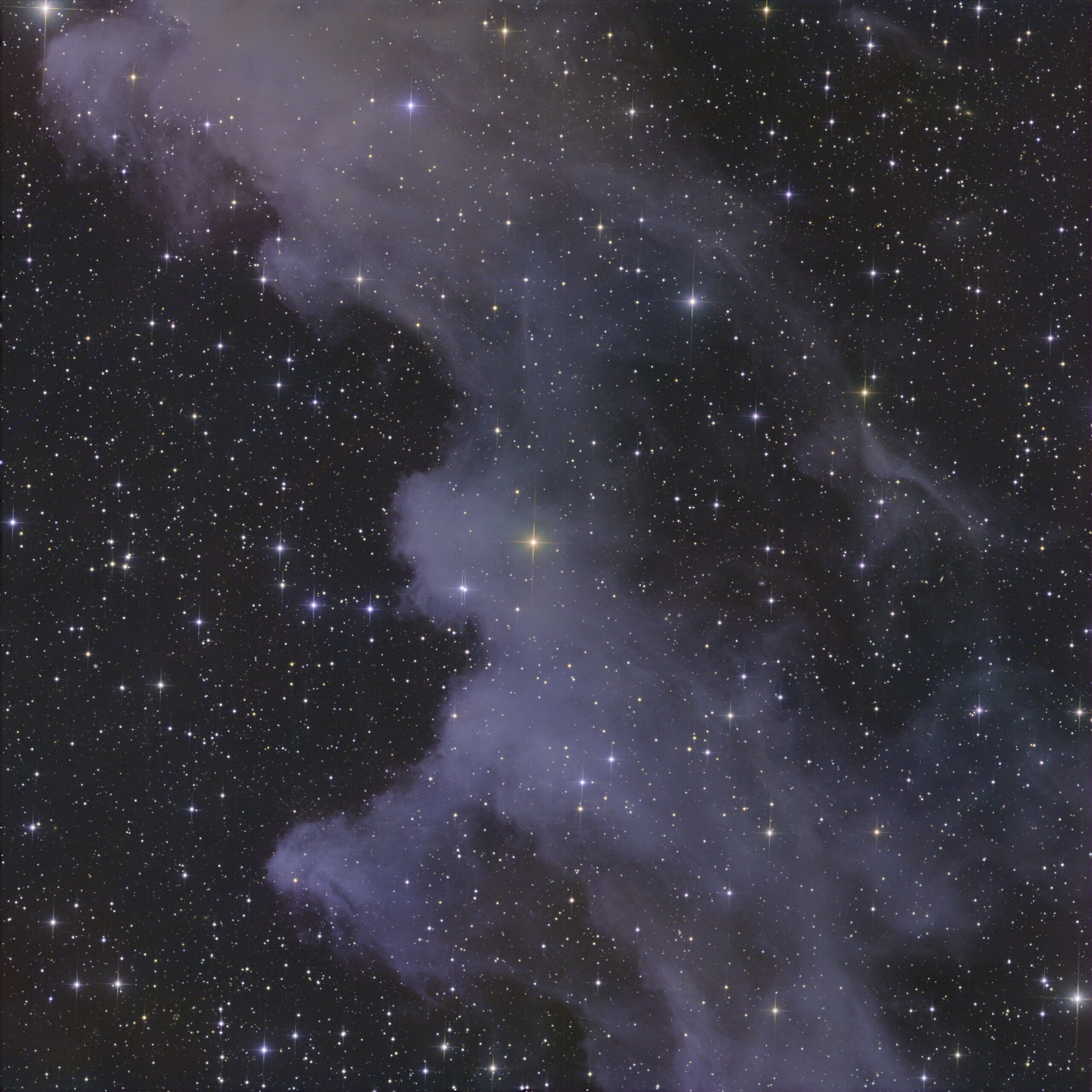
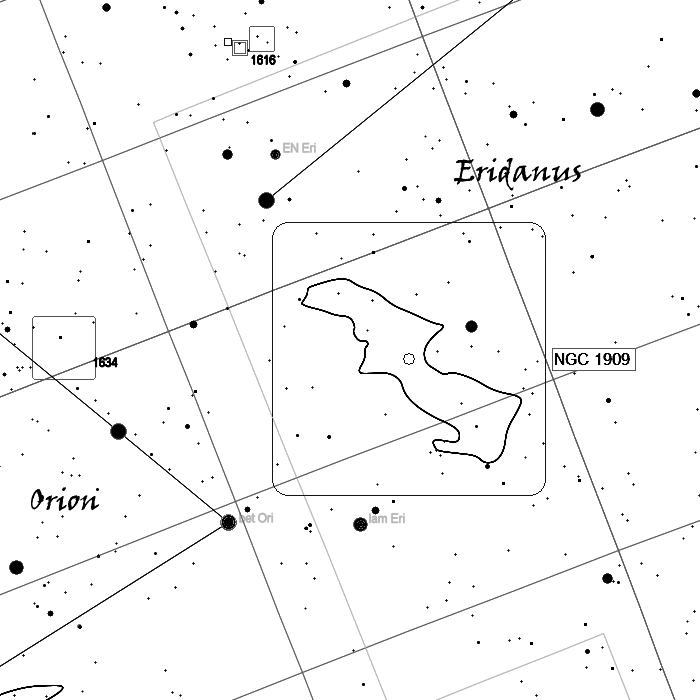
From time to time, I obtain data sets from remote observatories around the world. One of my favorite providers is the Insight Observatory, which operates telescopes in locations such as Chile, Namibia, and New Mexico. One of the data sets I received in 2020 features the extremely faint reflection nebula NGC 1909, located in the constellation Eridanus.
NGC 1909 is more widely known as the Witch Head Nebula, a name derived from its striking visual resemblance to a human profile. This appearance becomes evident in deep, wide-field images where the elongated, curved dust structures form what looks like a nose, chin, and flowing hair. The nebula spans a large region of the sky and is composed primarily of interstellar dust rather than ionized gas, making it fundamentally different from bright emission nebulae.
The illumination source of NGC 1909 is the bright blue supergiant star Rigel, one of the most luminous stars in the solar neighborhood. Located just outside the field in the constellation Orion, Rigel’s intense radiation is scattered by the dust particles within the nebula. This scattering process preferentially reflects shorter (blue) wavelengths of light, giving the nebula its characteristic bluish color. Unlike emission nebulae, which glow due to ionized hydrogen, reflection nebulae like NGC 1909 shine purely by reflected starlight, which also makes them significantly fainter and more challenging to capture.
At an estimated distance of around 900 light-years, NGC 1909 is part of the larger Orion–Eridanus superbubble, a vast region of interstellar space shaped by stellar winds and ancient supernova explosions. This environment has created a complex network of dust filaments and cavities, within which the Witch Head Nebula is embedded. The intricate structure visible in deep images reveals fine wisps, arcs, and gradients that trace the distribution of interstellar dust and its interaction with nearby stellar radiation.
From an imaging perspective, NGC 1909 is a demanding target due to its very low surface brightness. High-quality data, such as that provided by Insight Observatory, combined with careful calibration and processing, are essential to bring out the subtle contrast between the faint nebula and the surrounding sky background. The resulting image showcases delicate dust structures and smooth tonal transitions, highlighting the ethereal nature of this fascinating object and making it a rewarding subject for deep-sky astrophotography.
Data calibration and registration and the final processing was done with PixInsight. The result was as follows:
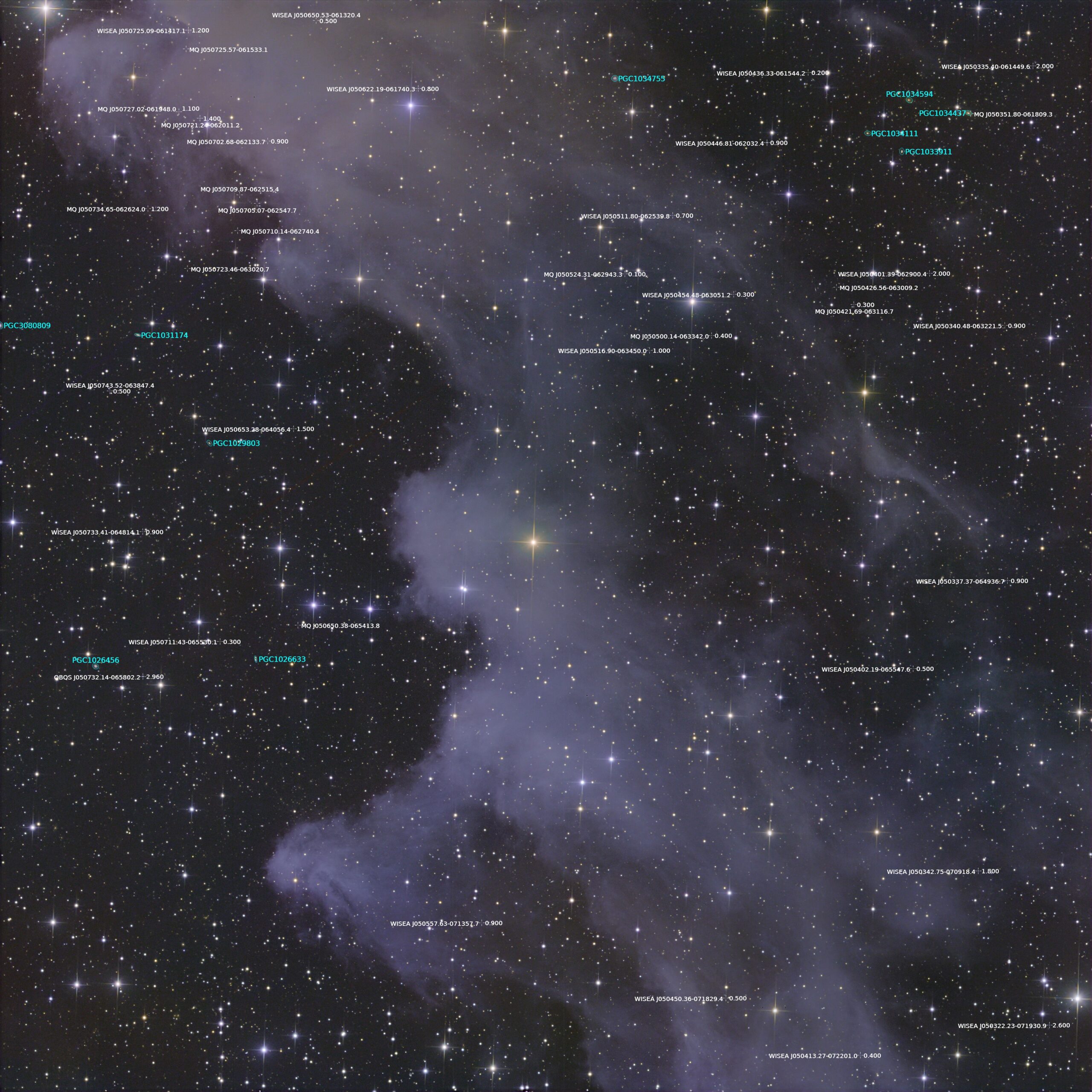
In the image you cand find some quasars. The most distant of them is
QBQS J050732.14-065802.2 with a redshift of z=2.96
The images were taken with the following equipment:
- Date: 2020
- Location.: New Mexico
- Telescope/Lens: Dreamscope 16″ f/3.7 Astrograph
- Focal length [mm]: 1525
- Focal ratio: 3.75
- Mount: Paramount ME
- Camera: FLI Proline 16803
- Filter: L:R:G:B
- Exposure time [min]: 110:60:60:60
- Resolution: 1.23″/px



Leave a reply