

Messier 98 and Messier 99 from remote
In 2025 I acquired a deep dataset of Messier 98 and Messier 99 using the VdS Remote Observatory in Hakos, Namibia. The excellent southern skies and long, uninterrupted exposures allowed for an exceptionally clean and detailed view of both galaxies within the Virgo Cluster region. In 2024, I had already received a high-resolution dataset of Messier 98 from Telescope Live Chile, taken with a larger telescope and longer total integration time, providing a far more detailed look into the galaxy’s dust lanes and inner structure.
From a scientific perspective, Messier 98 (NGC 4192) is a highly inclined spiral galaxy belonging to the Virgo Cluster, located roughly 44 million light-years away. Its edge-on orientation reveals complex dust bands and subtle signs of environmental interaction—possibly mild ram-pressure stripping as it moves through the intracluster medium. Messier 99 (NGC 4254), by contrast, is a striking grand-design spiral galaxy, notable for its intense star-forming regions and asymmetric spiral arm structure. Studies suggest that tidal interactions within the Virgo Cluster, or past encounters with nearby galaxies, may have triggered its lopsided morphology.
Combining the wide-field Namibia data with the detailed Chile dataset provides both context and structure: a deep view of the galaxies within their cluster environment, and a high-resolution insight into the internal physics shaping M98 and M99.
Data calibration and registration and the final processing was done with PixInsight. The result was as follows:

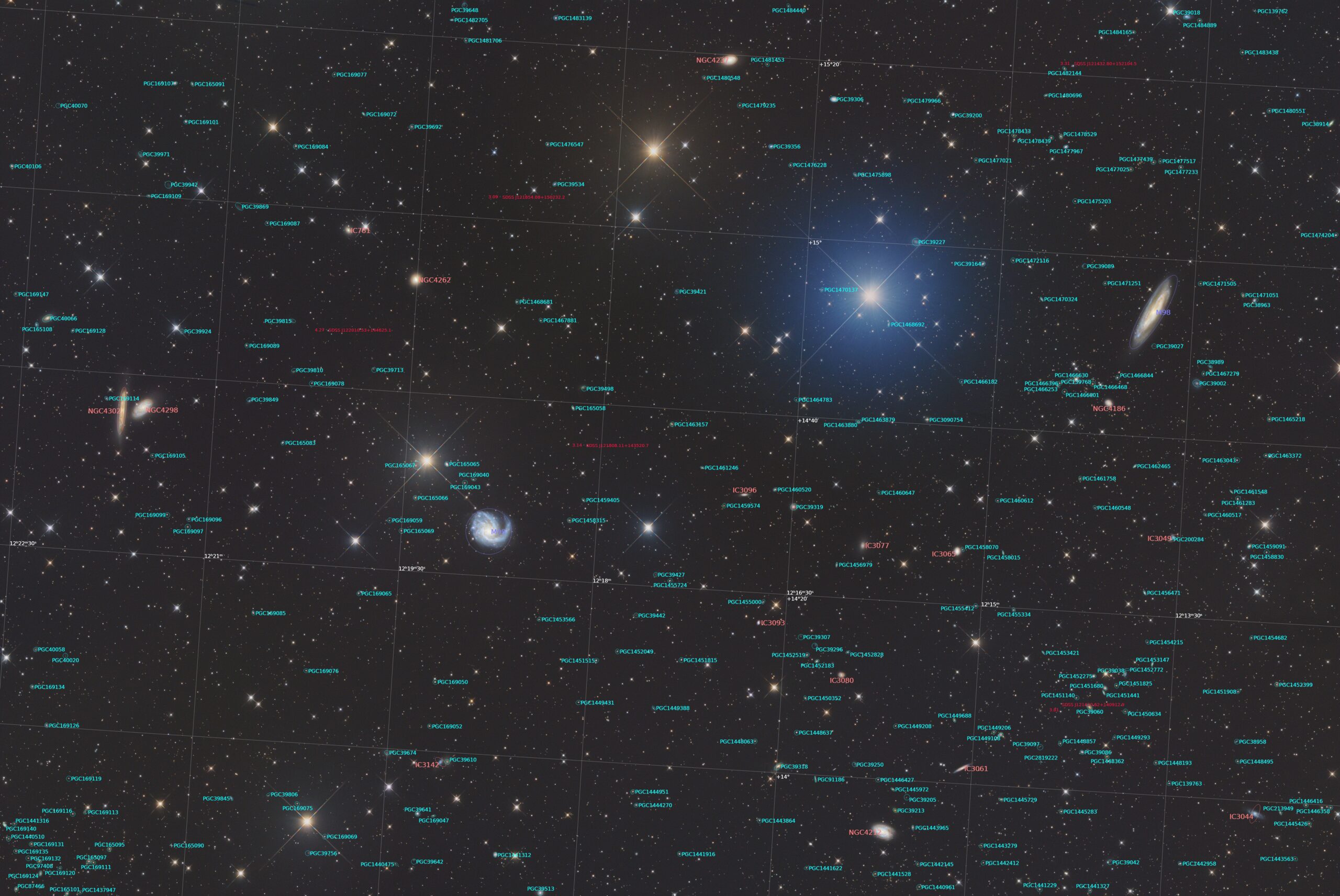
In the image were a lot of galaxies and quasars (see annotation). The most distant of them is:
SDSS J122010.53+144625.1 with a redshift of 4.27.
The faintest star in this image has an apparent magnitude of approx. 21.8 magv (SDSS DR17).
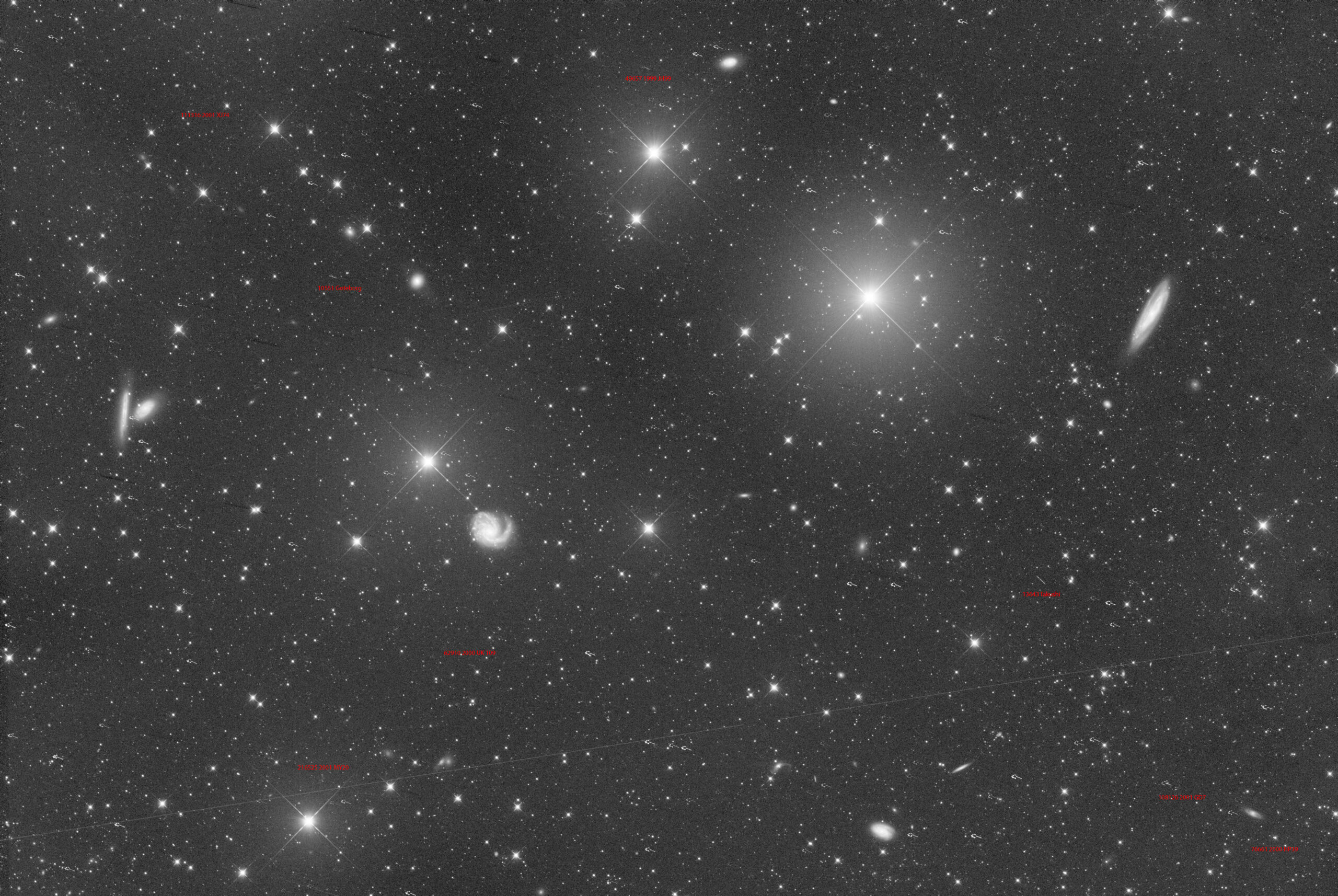
In the image are also some asteroids:
- 10551 Goteborg
- 13643 Takushi
- 49657 1999 JH99
- 62910 2000 UK109
- 76661 2000 HP39
- 108126 2001 GD7
- 111316 2001 XJ64
- 216525 2001 MY20
The images were taken with the following equipment:
- Date: 2025
- Location: Hakos, Namibia
- Telescope/Lens: Takahashi Epsilon 160D
- Focal length [mm]: 530
- Focal ratio: 3.6
- Mount: 10Micron GM3000
- Camera: Lacerta 2600C
- Filter: Clear
- Exposure time [min]: 153
- Resolution: 1.45″/px
Data calibration and registration and the final processing was done with PixInsight. The result was as follows:
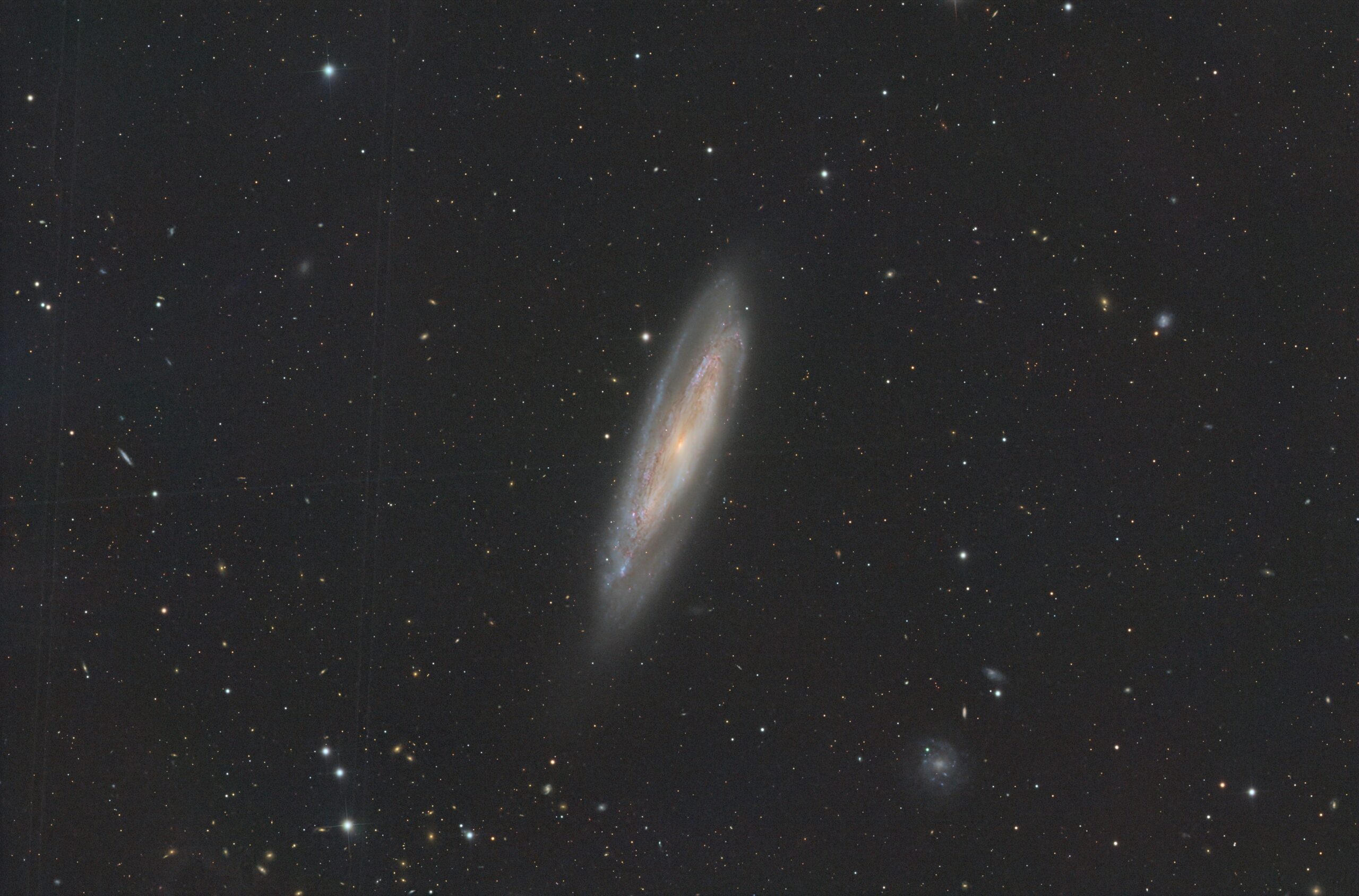
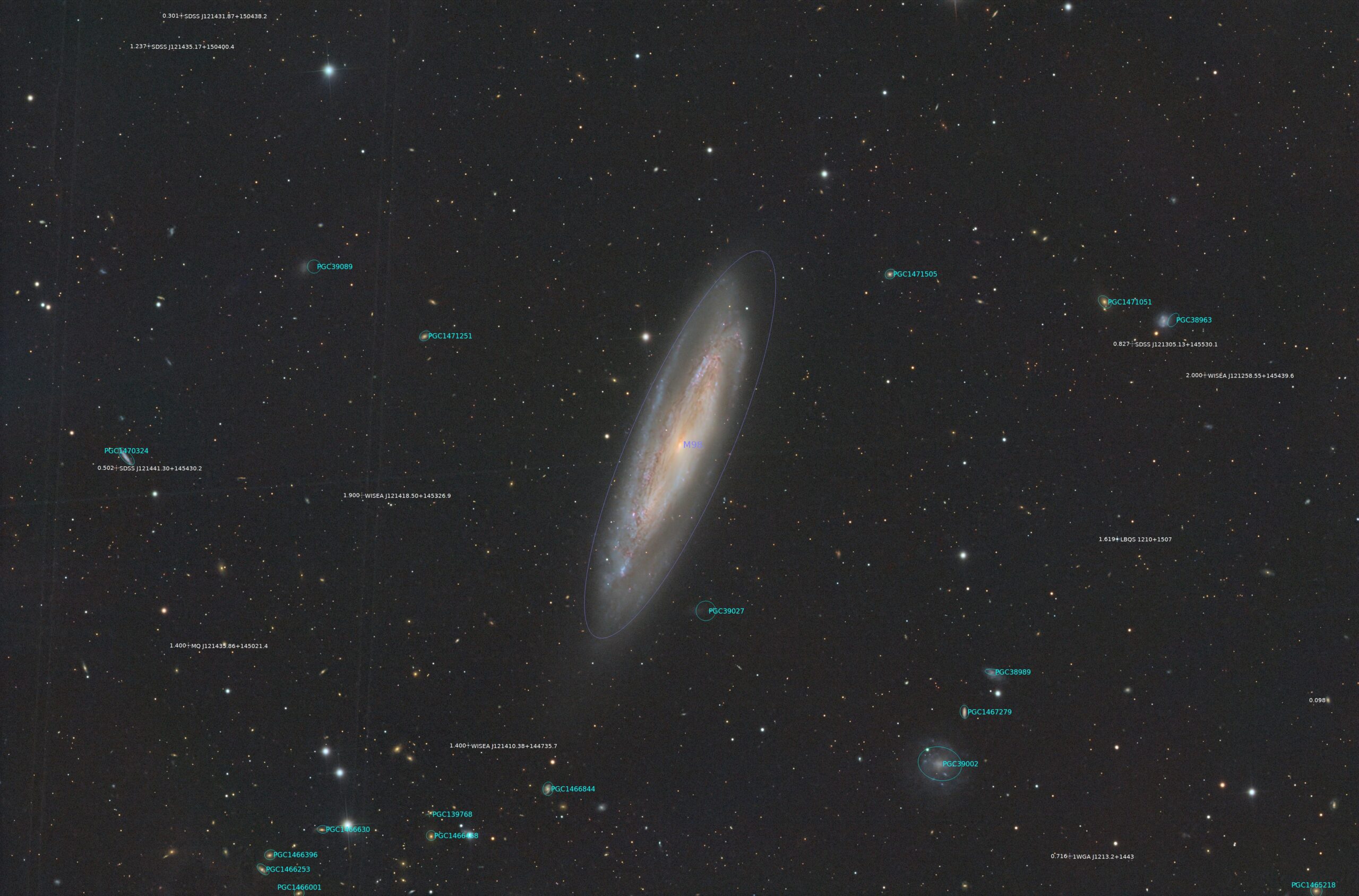
In the image were a lot of galaxies and quasars (see annotation). The most distant of them is:
WISEA J121258.55+145439.6 with a redshift of 2.0 an apparent magv of 21.5 (SDSS DR17).
The faintest star in this image has an apparent magnitude of approx. 22.6 magv (SDSS DR17).
The images were taken with the following equipment (Telescope Live, CHI-1):
- Date: 2024
- Location: El Sauce Observatory, Chile
- Telescope/Lens: Planwave CDK 24
- Focal length [mm]: 3962
- Focal ratio: 6.5
- Mount: Mathis MI-1000/1250
- Camera: QHY 600M Pro
- Filter: L:R:G:B
- Exposure time [min]: 135:130:145:145
- Resolution: 0.39″/px (bin 2)

Leave a reply