

Messier 97 and Messier 108 from my backyard and „Jade“ observatory
I imaged Messier 97 (the Owl Nebula) and Messier 108 (the Surfboard Galaxy) together in the same field on three occasions over the years. My first attempts came in 2010 and 2011, both using DSLR equipment from my backyard, where modest exposure times already revealed the striking contrast between the smooth planetary nebula and the dusty, edge-on spiral galaxy. Most recently, in 2025, I revisited this pair from my Jade Observatory, capturing a deep luminance dataset with modern CMOS hardware. I combined this high-resolution 2025 luminance with the 2011 RGB data to produce a new, significantly more detailed LRGB image of the field.
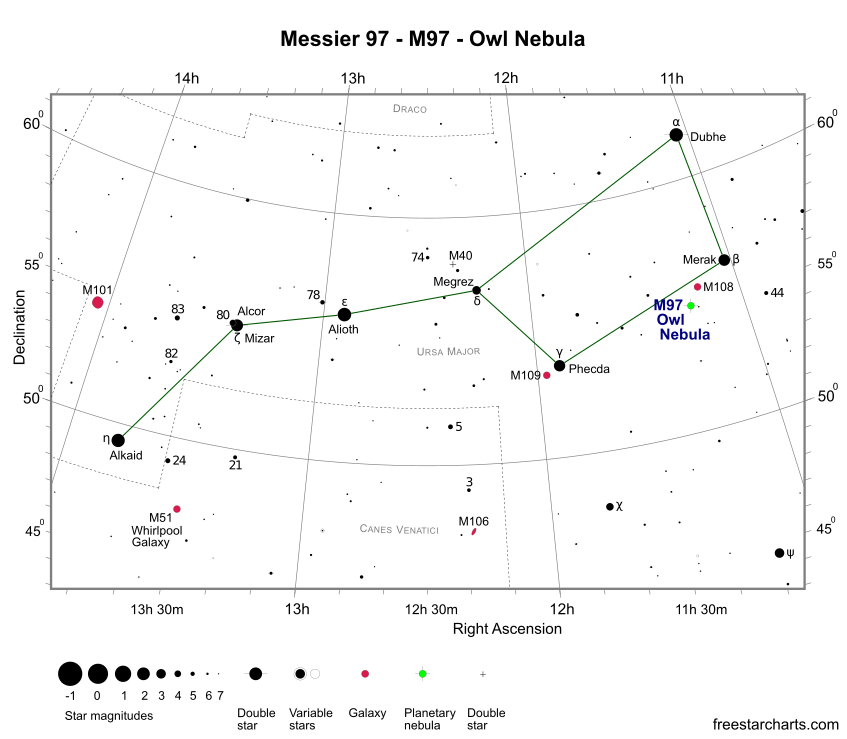
From a scientific perspective, Messier 97 is one of the brightest and nearest planetary nebulae, located about 2,500 light-years away in Ursa Major. Its characteristic “owl-like” appearance comes from two low-density cavities carved out by fast stellar winds from the hot central white dwarf. The nebula spans roughly 2 light-years and contains complex shells of ionized gas that respond strongly to deep luminance exposures—especially in [O III] and Hα.
In contrast, Messier 108 is an SBcd-type barred spiral galaxy seen almost perfectly edge-on at a distance of about 45 million light-years. Its chaotic dust lanes, scattered H II regions, and clumpy star-forming knots make it a rewarding target for high-contrast processing. Together, the pair offers a striking juxtaposition of a dying star in our own galaxy and an entire island universe far beyond.
Data calibration, registration and the final processing was done with PixInsight. The result was as follows:
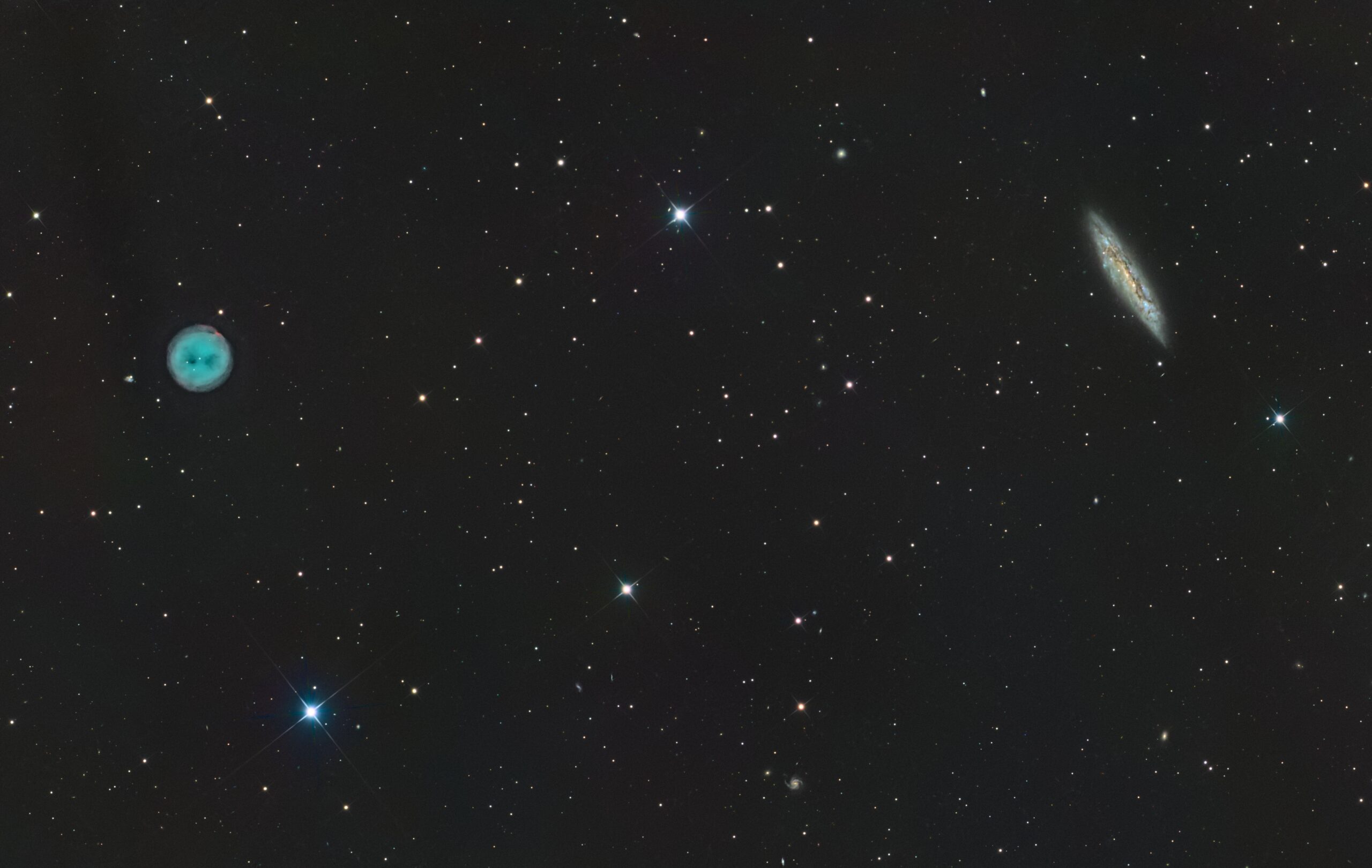
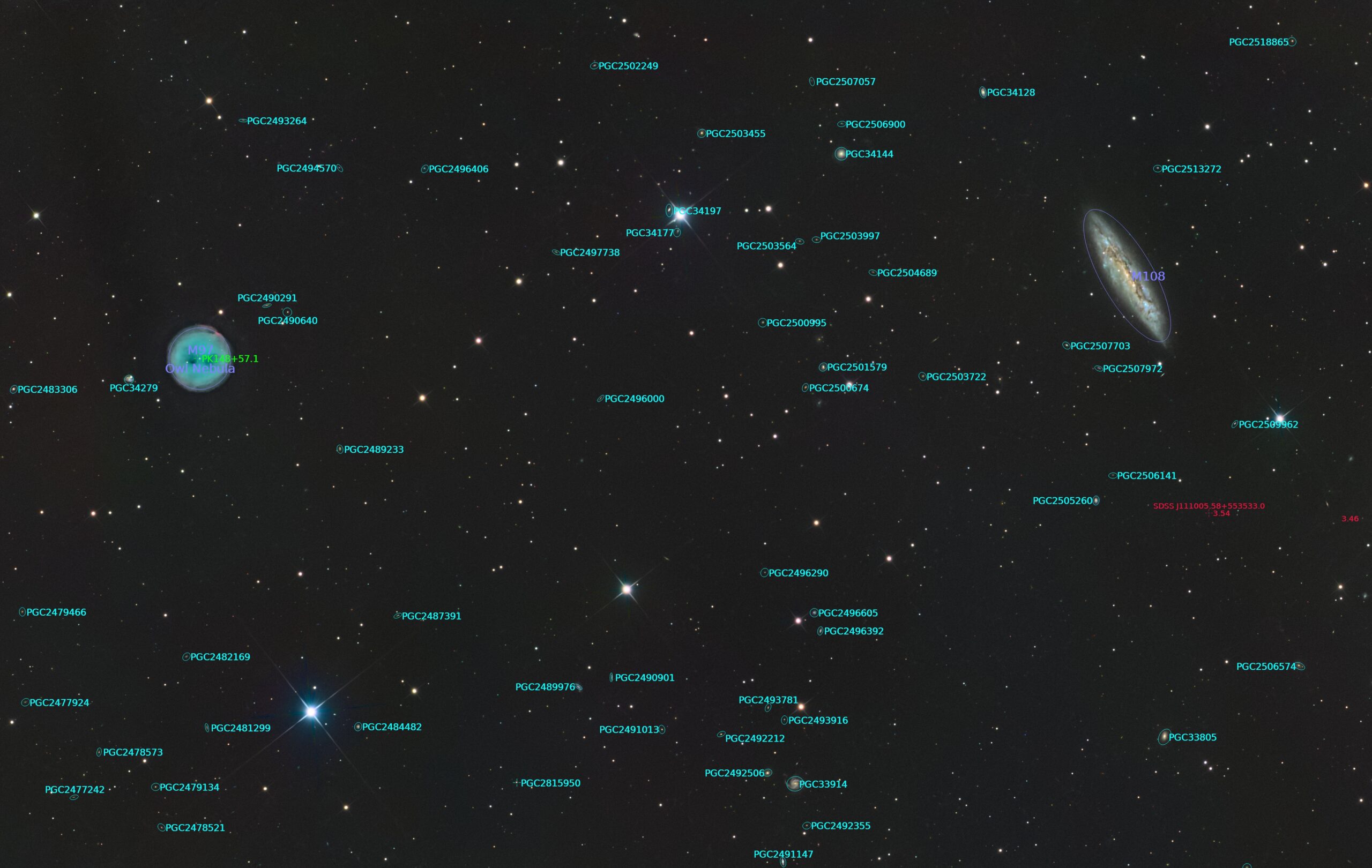
In the image are a lot of galaxies and also a lot of quasars. I show only the two most distant of them:
- SDSS J111005.58+553533.0 with a redshift of z=3.54
- SDSS J110927.18+554120.5 with a redshift of z=3.46
Here is an overview of the used equipment and the exposure times:
- Date: March 2025
- Location: Varel
- Telescope/Lense: 6″ Lacerta Newton
- Focal length [mm]: 600
- Focal ratio: 4
- Mount: Skywatcher EQ 8
- Camera: Lacerta Deepsky 2600 M
- Autoguiding: Off-Axis with ZWO Asi 120 MM Mini
- Filter: L
- Exposure time [min]: 96
- Resolution: 0.66″/px (2* Drizzle)
The 2011 data calibration and registration was performed with DeepSkyStacker, the final processing was done with PixInsight. The result was as follows:
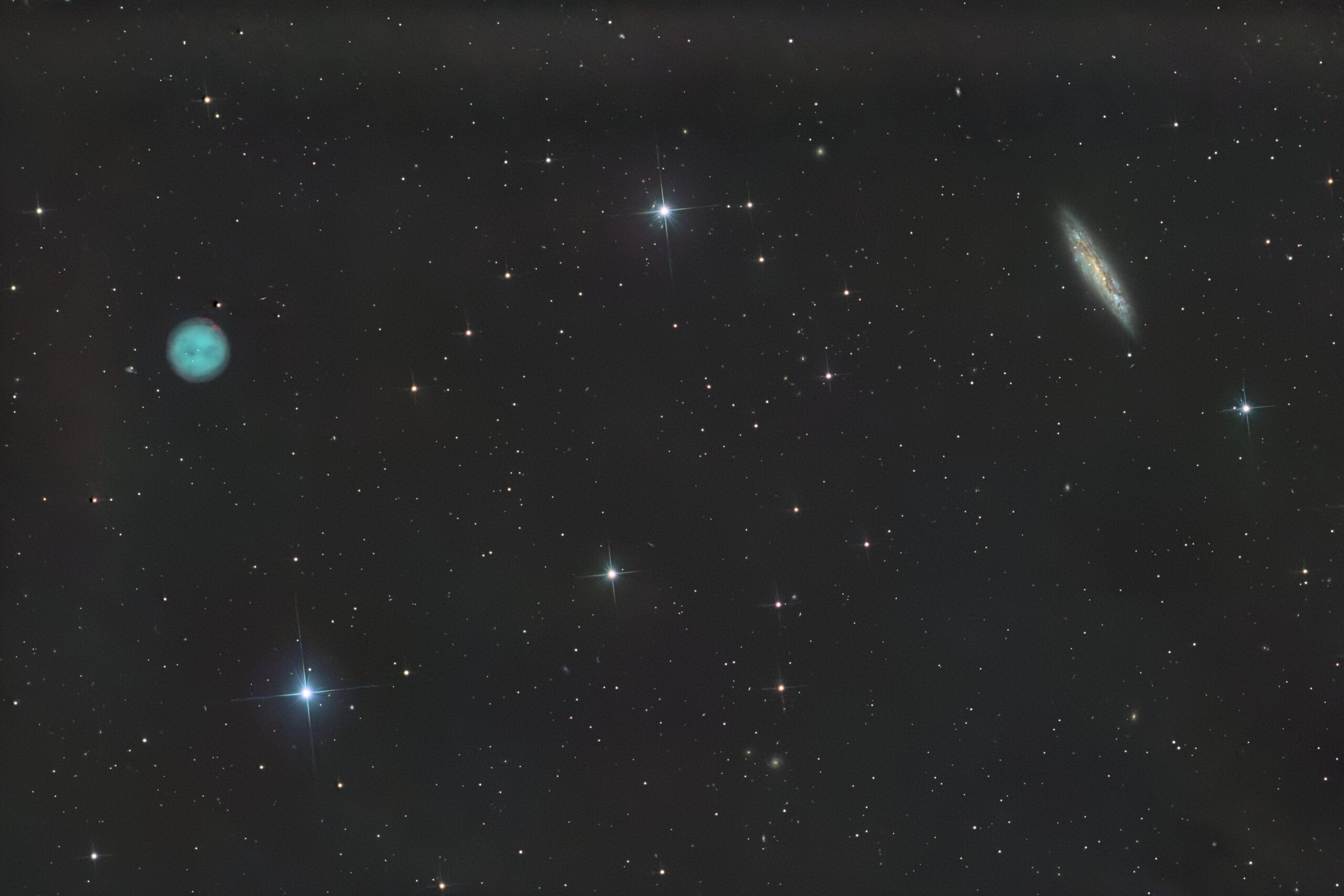
Here is an overview of the used equipment and the exposure times:
- Date: 2011
- Location: Krefeld
- Telescope/Lense: 8″ GSO Newton
- Focal length [mm]: 800
- Focal ratio: 4
- Mount: Skywatcher NEQ6
- Camera: Canon 500Da
- Autoguiding: no
- Filter: no
- Exposure time [min]: 137
- Resolution: 1.2″/px
The 2010 data calibration and registration was done with DeepSkyStacker, the final processing was performed with PixInsight. The result was as follows:
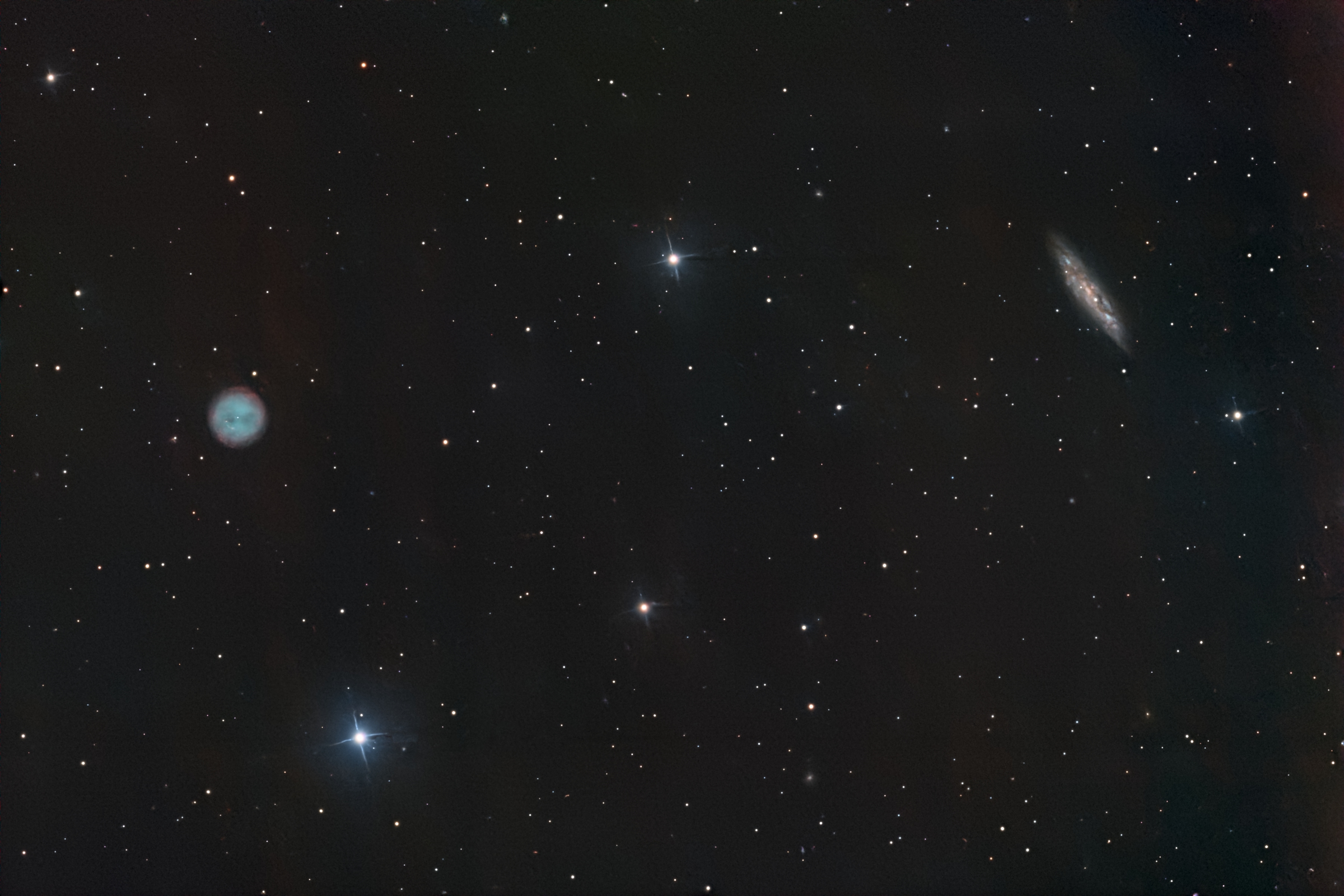
Here is an overview of the used equipment and the exposure times:
- Date: 2010
- Location: Krefeld
- Telescope/Lense: 8″ GSO Newton
- Focal length [mm]: 800
- Focal ratio: 4
- Mount: Skywatcher NEQ6
- Camera: Canon 300Da
- Autoguiding: no
- Filter: no
- Exposure time [min]: 130
- Resolution: 1.89″/px

Leave a reply