

Messier 83 (Southern Pinwheel Galaxy)
I imaged Messier 83 (the Southern Pinwheel Galaxy) for the first time in 2008 during a holiday at the Astrofarm Tivoli in Namibia. Using my own DSLR equipment under the exceptionally dark southern skies, I was able to capture the galaxy’s striking spiral structure despite the limitations of early DSLR technology. Tivoli’s superb conditions—high elevation, stable seeing, and very low light pollution—were ideal for photographing this low-latitude southern target, which is otherwise inaccessible from my home latitude.
In 2021, I received a high-quality dataset of Messier 83 from Telescope Live’s Chilean site. The larger telescope aperture, superior seeing, and much longer total exposure time yielded a dataset of significantly higher depth and resolution. Compared to my 2008 DSLR image, the Telescope Live data reveals far more detail in the star-forming regions, the complex dust lanes, and the extended outer arms of the galaxy. It also reaches much fainter background galaxies and traces the subtle low-surface-brightness features that are nearly impossible to capture with DSLR equipment alone.
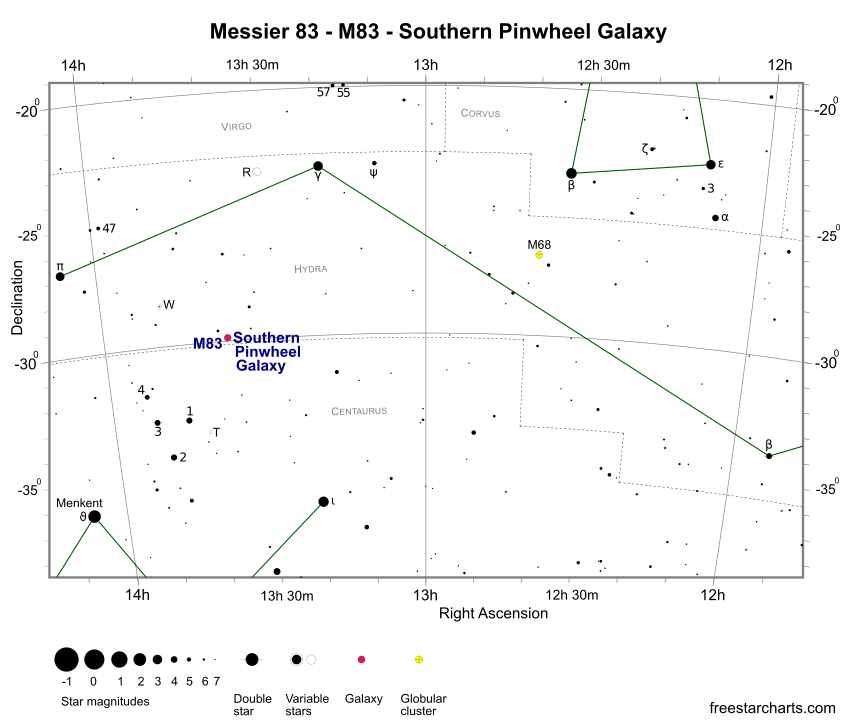
Messier 83 (NGC 5236) is one of the nearest and most active barred spiral galaxies, located roughly 15 million light-years away in the constellation Hydra. Classified as an SAB(s)c galaxy, it displays a strong central bar and multiple grand-design spiral arms rich in H II regions, supernova remnants, and massive star-forming complexes. Its high rate of star formation has earned it the reputation of a starburst galaxy, particularly in its nuclear region.
M83 is part of the Centaurus A / M83 galaxy group, one of the closest major galaxy groups to the Milky Way. It has undergone several minor mergers and tidal interactions, as evidenced by faint stellar streams and tidal plumes in its outer halo—features that deep imaging datasets can reveal. With at least six recorded supernovae, M83 is one of the most prolific supernova hosts in the Messier catalog, making it an important object for the study of stellar evolution and galactic feedback.
The galaxy’s central region also harbors a complex structure including a double nucleus, possibly the relic of a past merger. Infrared and X-ray observations show intense starburst activity fed by gas inflow along the bar, contributing to the rich population of young, massive stellar clusters.
From an astrophotographic perspective, M83 is both visually stunning and scientifically rich. Its combination of bright arms, intricate dust lanes, extended faint halo structures, and active central region makes it one of the most rewarding southern-sky targets—especially when imaged from dark locations like Namibia or through high-quality remote observatories in Chile.
Data calibration and registration and the final processing was done with PixInsight. The result was as follows:
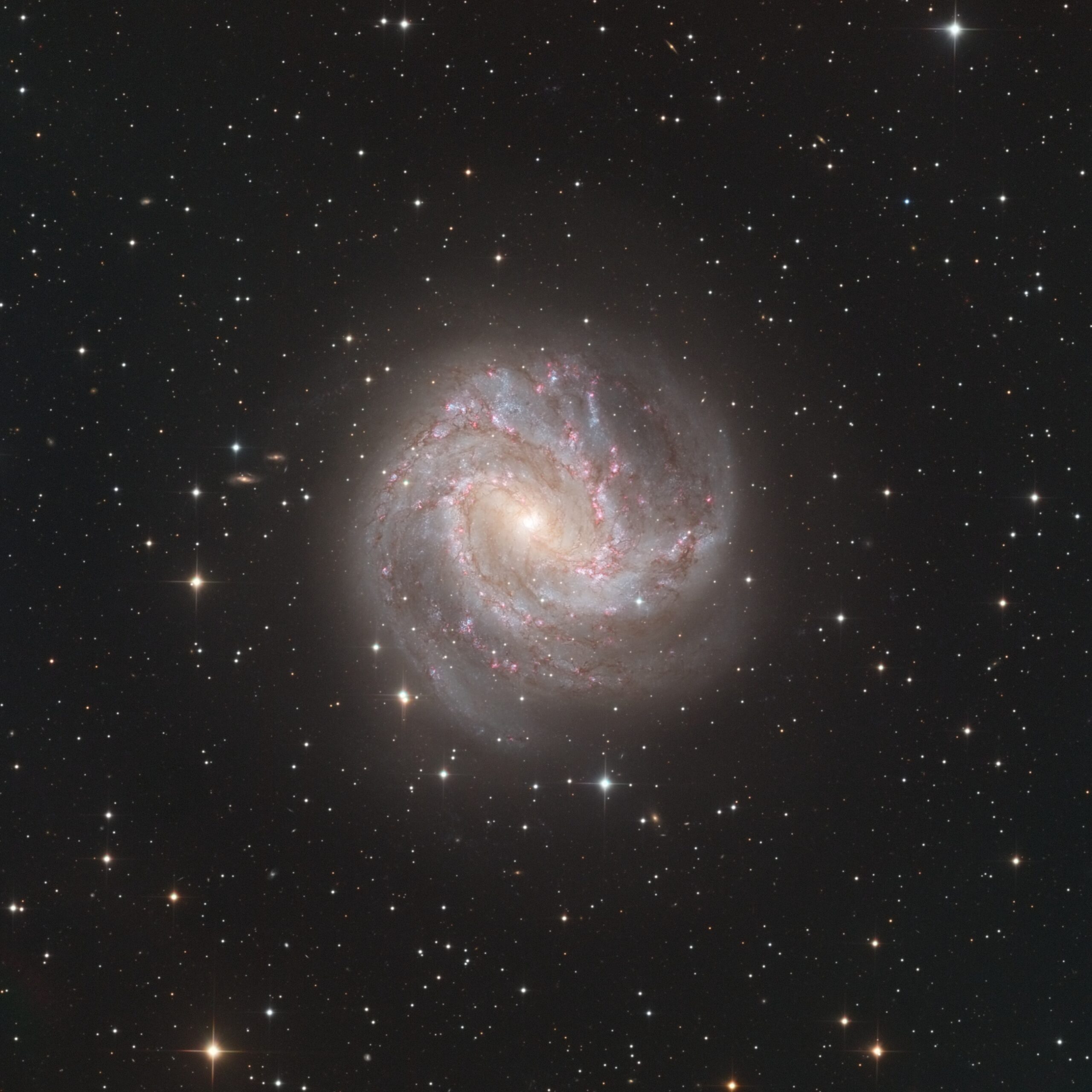
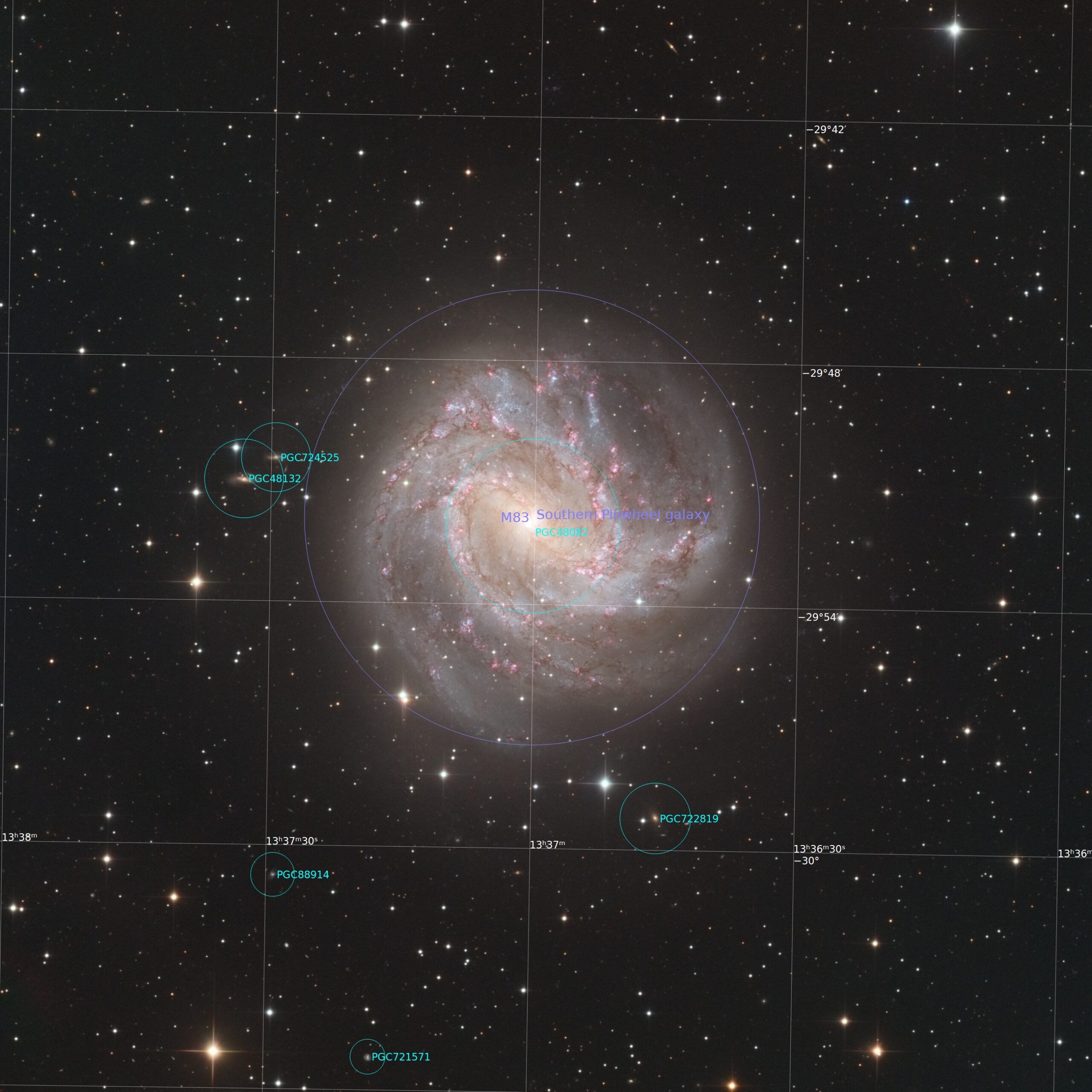
The images were taken with the following equipment (Telescope Live CHI-1):
- Date: 2023
- Location: El Sauce Observatory, Chile
- Telescope/Lens: Planwave CDK24
- Focal length [mm]: 3900
- Focal ratio. 6.5
- Mount: Mathis MI-1000/1250
- Camera: FLI Proline 9000
- Filter: L:R:G:B
- Exposure time [min]: 80:200:170:270
- Resolution: 0.62/px
The 2008 data calibration and registration was performed with DeepSkyStacker and the final processing was done with PixInsight. The result was as follows:

The images were taken with the following equipment:
- Date: 2008
- Location: Astrofarm Tivoli, Namibia
- Telescope/Lens: Pentax 75
- Focal length [mm]: 500
- Focal ratio. 6.7
- Mount: Vixen Atlux
- Camera: Canon 300Da
- Filter: no
- Exposure time [min]: 72
- Resolution: 3.04/px

Leave a reply