

Messier 78 (NGC 2068) from my backyard and Namibia
I imaged Messier 78 twice over the years, capturing two very different perspectives of this striking reflection nebula. My first attempt was in 2007, using DSLR equipment from my light-polluted backyard. Despite the limited conditions, the characteristic blue reflection glow of M78—caused by starlight scattering off fine interstellar dust—was already faintly visible. A more dramatic improvement came in 2013, when I revisited the object under the pristine, exceptionally dark skies of the Astrofarm Tivoli in Namibia. Equipped with a larger telescope and a CCD camera, the nebula revealed far more detail: intricate dust lanes, subtle gradients in the reflection haze, and the faint surrounding nebulosity that is nearly impossible to detect from urban locations.
Messier 78, also catalogued as NGC 2068, is one of the most prominent reflection nebulae within the Orion Molecular Cloud Complex, a vast star-forming region located roughly 1,350 light-years from Earth. Unlike emission nebulae, which glow due to ionized gas, M78 shines by reflected starlight: its characteristic blue colour in broadband images arises from fine dust grains scattering the light of nearby hot, young stars. The nebula is illuminated primarily by the B-type stars HD 38563A and HD 38563B, whose intense radiation fields carve out cavities in the surrounding cloud material.
Deep imaging reveals that M78 is far from a static cloud—it is a dynamic stellar nursery. Embedded within the nebula are numerous young stellar objects (YSOs), many still shrouded in thick envelopes of gas and dust. The region hosts an impressive collection of Herbig–Haro objects (HH 19, HH 24, HH 26, among others), which are the visible signatures of protostellar jets ploughing through the interstellar medium at high velocities. These shocked gas knots trace active accretion processes and help astronomers map the early evolution of low-mass stars.
The dust structures within M78 are particularly complex. Filamentary lanes weave through the nebula, indicating regions of varying density shaped by turbulence, stellar winds, and gravitational collapse. Infrared observations have shown that the apparently dark voids are not empty but rich in cooler dust, invisible to optical detectors. Faint surrounding nebulae such as NGC 2071 and NGC 2064 also belong to the same cloud complex and can be captured in deeper exposures under dark skies.
Because of its combination of bright reflection regions, delicate dust filaments, and actively forming stars, Messier 78 is a scientifically rich and visually rewarding target. The contrast between your 2007 backyard image and the 2013 deep CCD exposure from Tivoli illustrates perfectly how dark skies and larger optics reveal the subtle structures and ongoing star formation processes within this iconic Orion nebula.
Data calibration and registration were performed with DeepSkyStacker, and the final processing was completed in PixInsight.
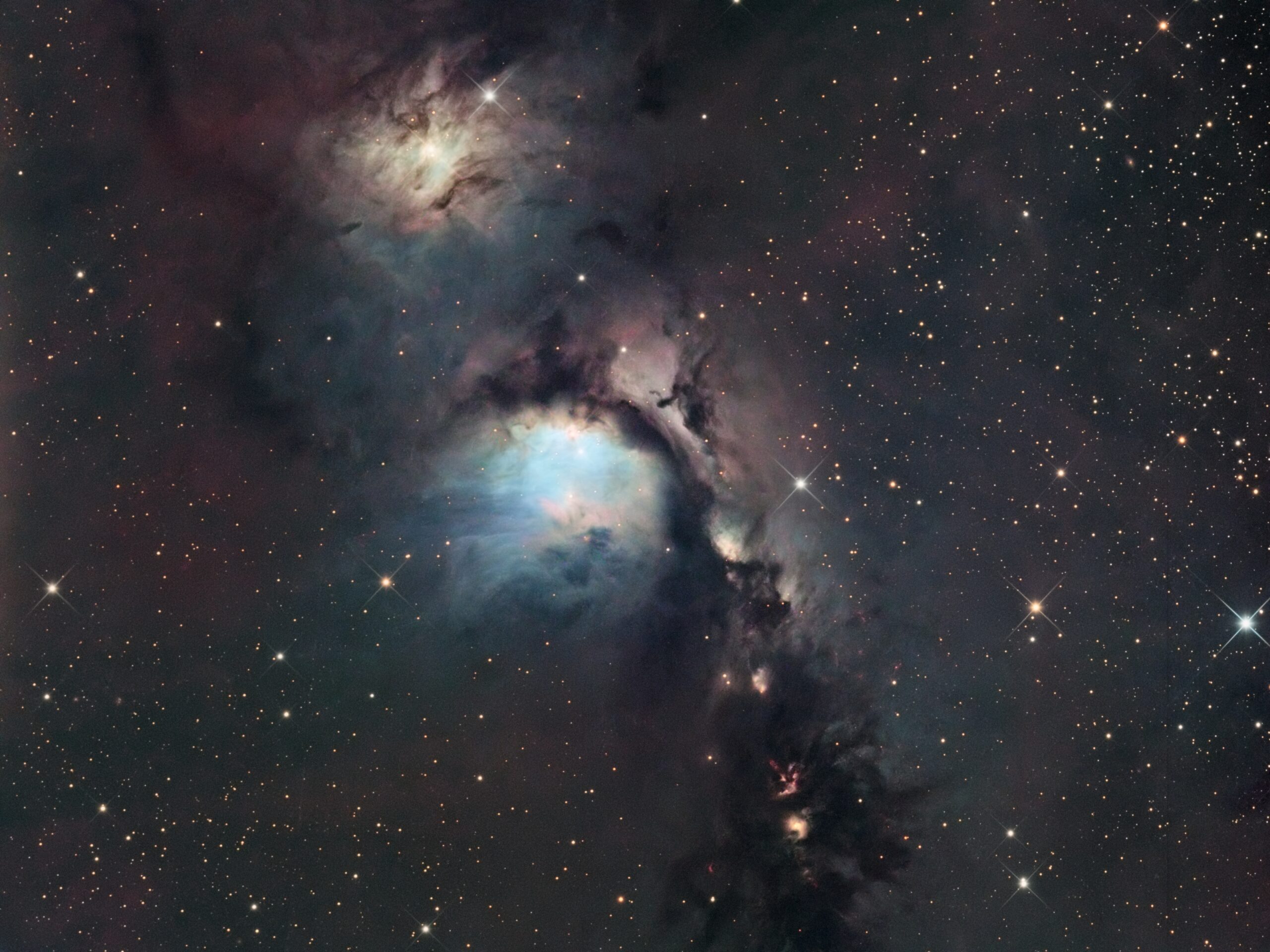
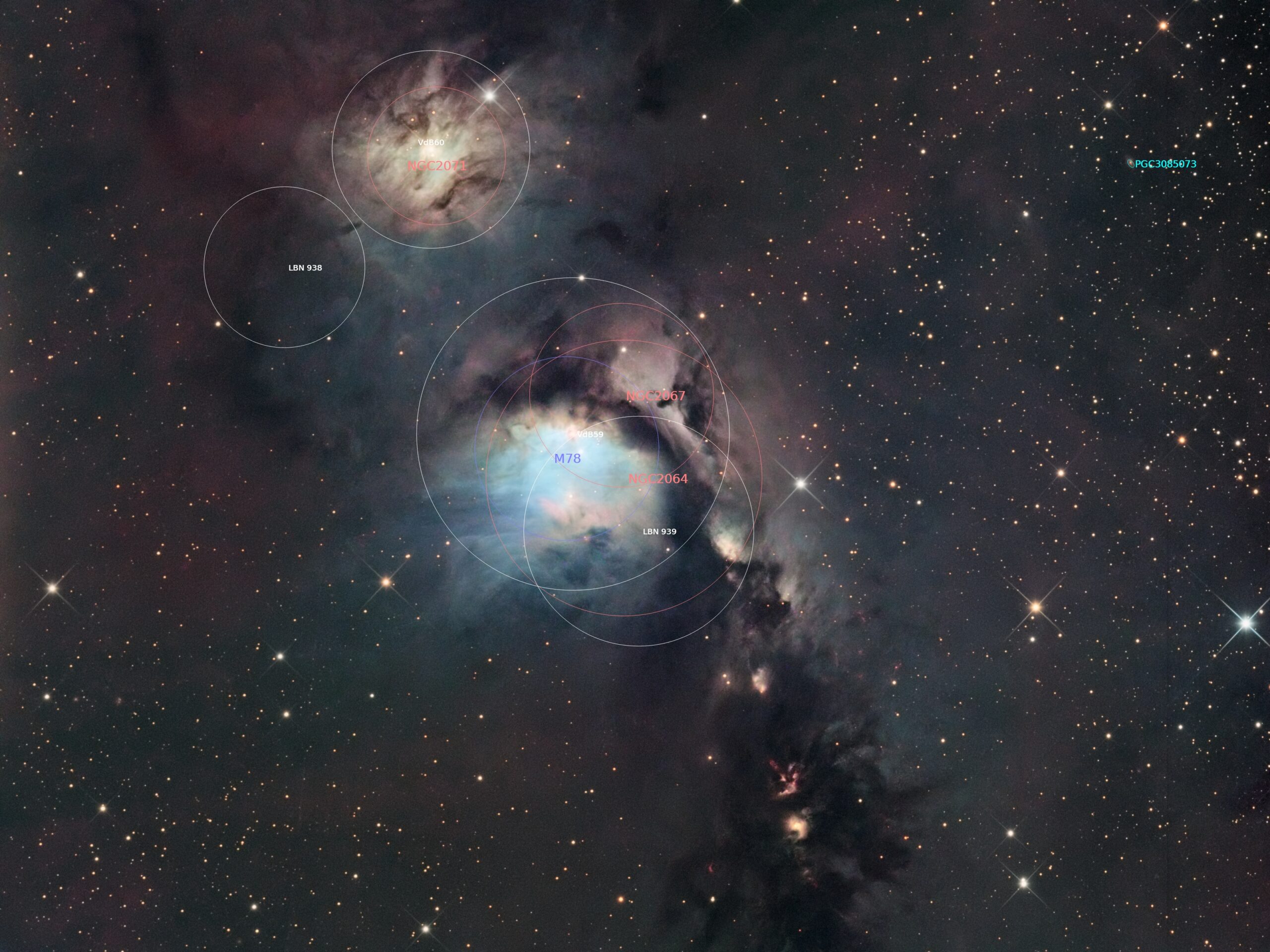
The images were taken with the following equipment:
- Date: 2013
- Location: Astrofarm Tivoli, Namibia
- Telescope: 12″ ASA Astrograph
- Focal length [mm]: 1076
- Focal ratio: 3.6
- Mount: ASA DDM 85
- Camera: FLI Microline ML8300
- Filter: L:R:G:B
- Exposure time [min]: 60:60:60:60
- Resolution: 1.04″/px
Data calibration and registration of the 2007 data was performed in DeepSkyStacker, the final processing was performed in PixInsight.
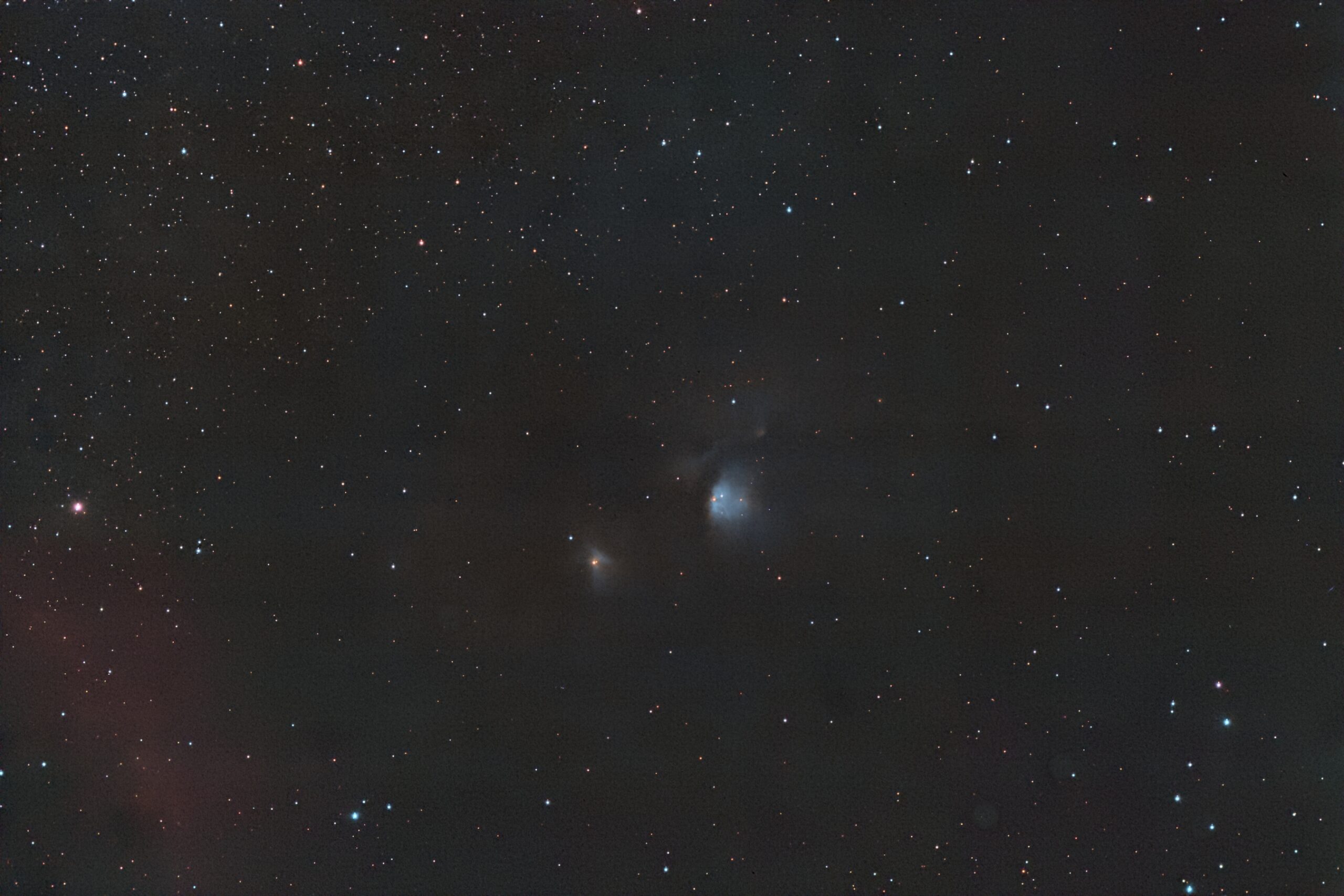
The images were taken with the following equipment:
- Date: 2007
- Location: Krefeld, Germany
- Telescope: Pentax 75
- Focal length [mm]: 500
- Focal ratio: 6.7
- Mount: Vixen GP-DX
- Camera: Canon 300Da
- Filter: OSC
- Exposure time [min]: 20
- Resolution: 3.04″/px

Leave a reply