

Messier 64 (Black Eye Galaxy)
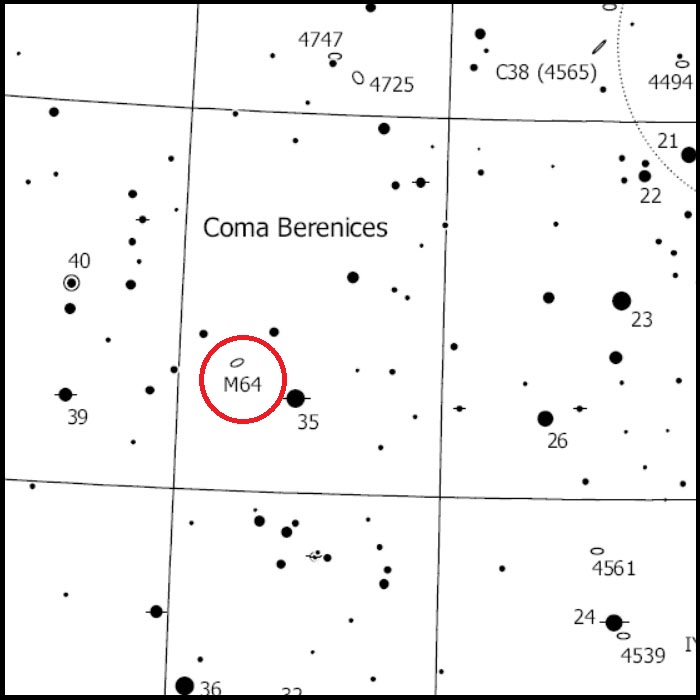
I have been subscribing to data from the Deep Sky West (DSW) Observatory for several years. Located in New Mexico, DSW operates multiple fully equipped remote imaging systems under dark, high-altitude skies, providing consistently high-quality data for deep-sky astrophotography. Among the datasets I received in 2018 was a series of exposures of the intriguing Messier 64 (M64), also known as the Black Eye Galaxy, situated in the constellation Coma Berenices.
M64 is well known for its striking appearance: a bright, smooth central bulge partially obscured by a prominent dark dust lane, which gives the galaxy its characteristic “black eye.” Scientifically, it is fascinating due to its counter-rotating gas disk, a phenomenon believed to be the result of a past galactic merger or accretion event. High-quality remote data are particularly valuable for capturing the fine dust structures and subtle color gradients within M64’s disk and halo.
Before receiving the DSW dataset, I had previously imaged this galaxy in 2011 using a DSLR camera from my backyard. While the earlier image revealed the basic morphology and the dark lane, it was limited by local light pollution and the sensitivity of DSLR sensors. The 2018 DSW data provided significantly greater depth, sharper star profiles, and far better signal-to-noise ratio, allowing for a much more detailed and scientifically accurate final result.
Data calibration and registration and the final processing was done with PixInsight. The result was as follows:


The faintest star in this image has an apparent magnitude of 23.1 magv (SDSS DR15).
The two highest redshift quasars [Flesh 2015] in the image are:
- SDSS J125531.36+212557.3 z=3.34 magG=21.2 (Gaia DR2)
- SDSS J125431.89+210315.9 z=3.28 magG=19.7 (Gaia DR2)
The images were taken with the following equipment:
- Date: 2018
- Location: Rowe, New Mexico
- Telescope/Lens: Astrophysics RH305
- Focal length [mm]: 1159
- Focal ratio: 3.8
- Mount: Paramount ME
- Camera: SBIG STX-16803
- Filter: L:R:G:B
- Exposure time [min]: 205:95:120:125
- Resolution: 1.66″/px
The 2011 data was calibrated and registered in DeepSkyStacker and finally processed in PixInsight. The result was as follows:

The images were taken with the following equipment:
- Date: 2011
- Location: Krefeld, Germany
- Telescope/Lens: Orion 10″ Newton
- Focal length [mm]: 1200
- Focal ratio: 4.8
- Mount: Skywatcher NEQ6
- Camera: Canon 500Da
- Filter: OSC
- Exposure time [min]: 414
- Resolution: 1.66″/px

Leave a reply