

Messier 55 (NGC 6809)
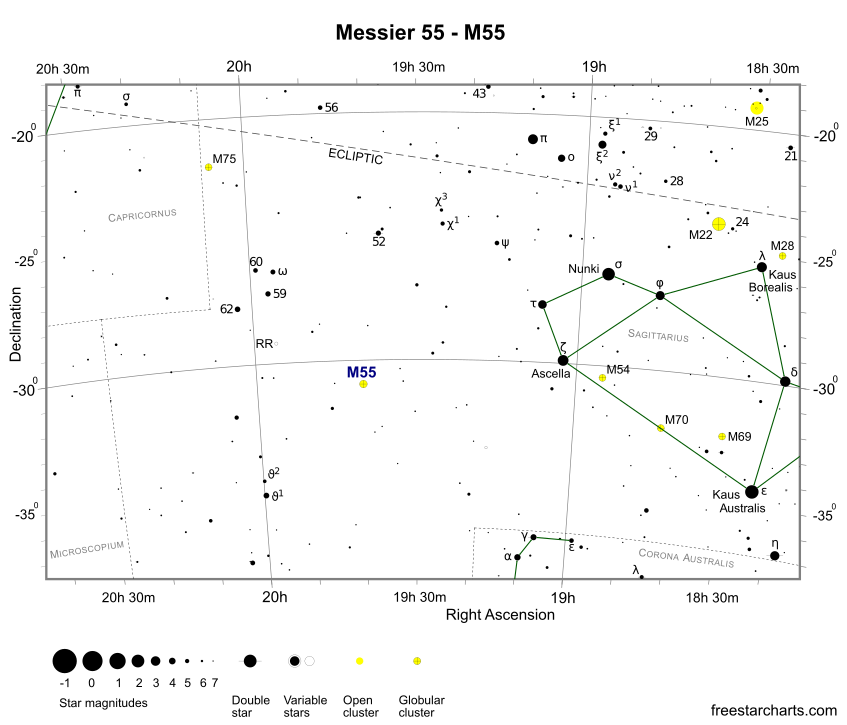
From time to time, I obtain datasets from remote observatories to complement my own imaging projects and to explore targets visible primarily from the southern hemisphere. One of these data providers is the Goldfield Astronomical Observatory, which operates telescopes in Australia under dark and stable sky conditions ideal for deep-sky imaging. Among the datasets I received from this facility was an excellent series of exposures of the globular cluster Messier 55 (M55), located in the constellation Sagittarius.
M55 is a relatively loose and bright globular cluster, notable for its large apparent diameter and low central concentration compared to other members of its class. The raw data from Goldfield exhibited well-exposed stellar profiles and consistent image quality across all subframes, providing a solid basis for precision calibration and integration.
The data calibration, including dark, bias, and flat-field correction, as well as image registration and final processing, were performed using PixInsight. Particular attention was given to star color calibration and dynamic range optimization to preserve the natural color distribution of the cluster’s stellar population. The final image reveals M55’s extended halo and rich field of foreground and background stars—an impressive example of the observational potential of remotely operated telescopes in the southern hemisphere.

The images were taken with the following equipment:
- Location: Goldfield Astronomical Observatory, Australia
- Telescope/Lens: Takahashi Mewlon 250
- Focal length [mm]: 2500
- Focal ratio: 10
- Mount: ASA DDM60
- Camera: ZWO ASI 094MC
- Filter: OSC
- Exposure time [min]: 90
- Resolution: 0.40″/px

Leave a reply