

Messier 109 (NGC 3992) from my backyard
I imaged Messier 109 (M109) on two occasions, in 2015 and 2016, both times from my backyard in Krefeld using the same CCD camera and 10″ Newtonian setup. Because the equipment and exposure times were identical, I later combined both datasets into a single, deeper final image, improving the signal-to-noise ratio and revealing more subtle structures in the galaxy’s faint outer disk.
Scientifically, M109 is a barred spiral galaxy (SBc) located in the constellation Ursa Major, roughly 83 million light-years away. It is the brightest member of the extended Ursa Major Galaxy Group, one of the nearest large-scale galaxy associations to the Local Group. The galaxy is characterized by a prominent central bar, tightly wound spiral arms, and a surrounding low-surface-brightness disk that becomes more apparent with long integrations—something clearly beneficial in a multi-year combined dataset. M109 also hosts a supermassive black hole, though relatively quiescent, and exhibits subtle signs of interaction with its faint dwarf companions, making it an interesting target both aesthetically and scientifically.
Data calibration and registration was performed with DeepSkyStacker, the final processing was done with PixInsight. The result was as follows:

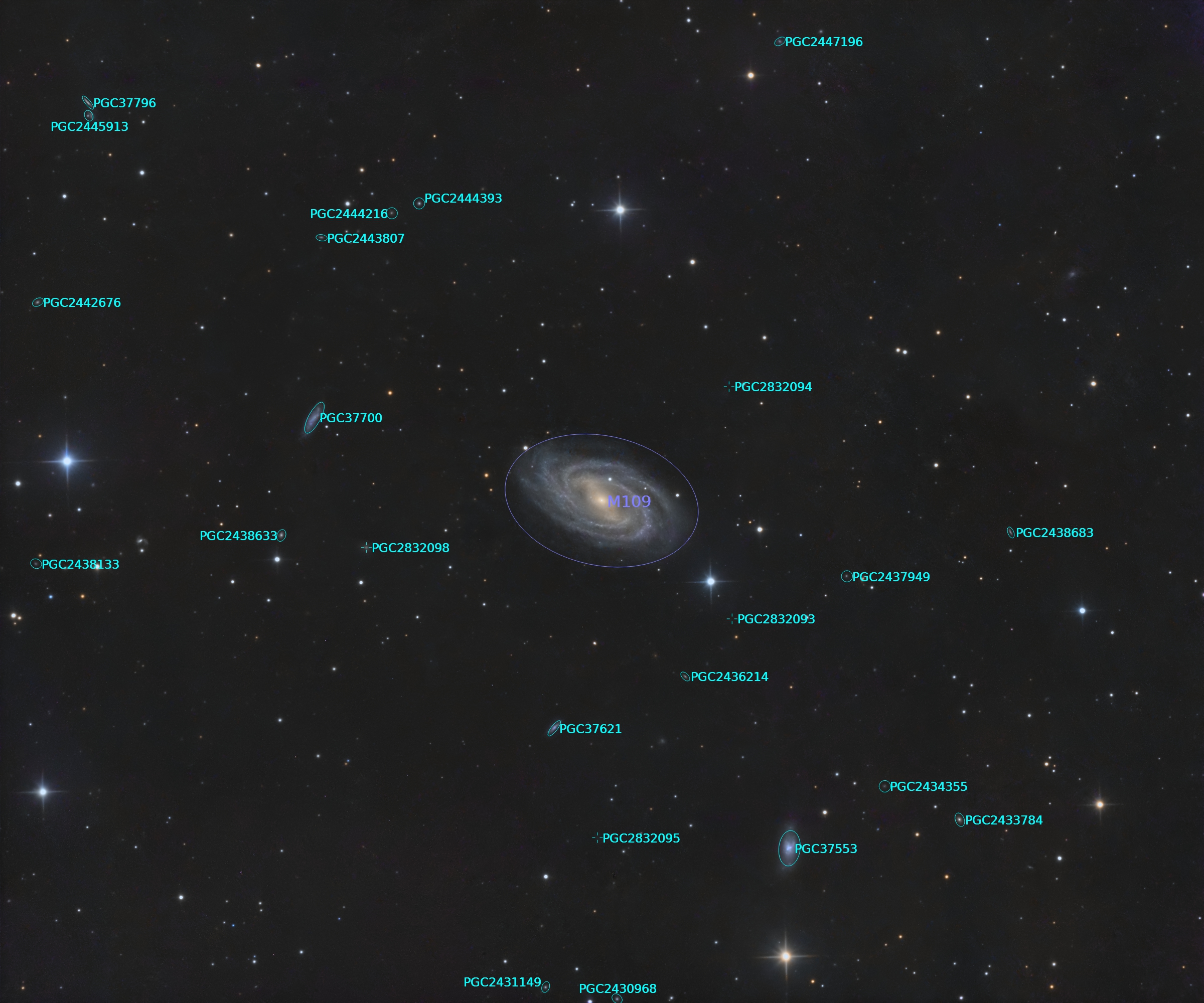
Here is an overview of the used equipment and the exposure times:
- Date: 2015, 2016
- Location: Krefeld, Germany
- Telescope/Lens: 10″ Newton ohne Namen
- Focal length [mm]: 1000
- Focal ratio: 4
- Mount: Losmandy G11
- Camera: Moravian 8300FW
- Filter: R:G:B
- Exposure time [min]: 120:120:120
- Resolution: 1.11″/px

Leave a reply