

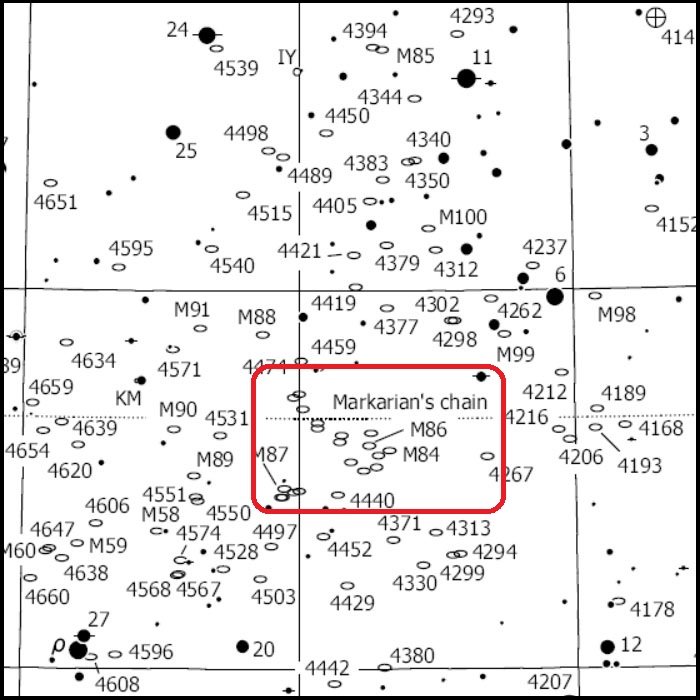
Markarian’s chain
In 2010 I captured my first images of Messier 84, Messier 86, and the surrounding region known as Markarian’s Chain using my own equipment. Although my setup at the time was modest compared with what I use today, the results already provided a fascinating glimpse into this rich and dynamic part of the Virgo Cluster. The Chain is a rewarding target even for smaller telescopes thanks to its high galaxy density and the wide range of morphologies present in a relatively compact field.
In 2018 I had the opportunity to work with a significantly more advanced dataset from Deep Sky West (DSW) in New Mexico. This material, taken under some of the finest skies in the continental United States and with a larger telescope, offered far deeper exposures, higher resolution, and more stable seeing conditions. Combining this modern data with my earlier experiences provided not only a visual improvement, but also a much broader scientific appreciation of the region.
Markarian’s Chain is a striking, semi-linear arrangement of galaxies that forms part of the Virgo Cluster, the nearest large galaxy cluster to the Milky Way at a distance of roughly 54 million light-years. Although the alignment appears chain-like in optical imagery, only some members are physically associated in space; others are chance projections. The most prominent galaxies in this field include the giant lenticular Messier 84 (NGC 4374) and the elliptical Messier 86 (NGC 4406).
M84 is an elliptical or lenticular galaxy thought to host a supermassive black hole of roughly 10⁹ solar masses. It is known for its bright central region and subtle dust lanes. M86, on the other hand, is blueshifted relative to the Milky Way—meaning it is moving toward us. This motion reflects its high-speed trajectory through the Virgo Cluster, likely the result of complex gravitational interactions with the cluster’s core. M86 is part of a substructure known as the Virgo A–M86 subgroup, a system of galaxies and dark matter clumps currently falling inward toward the main Virgo Cluster potential well.
The region is also embedded in a large-scale network of ionized gas filaments, intracluster medium (ICM), and gravitational interactions. Many of the galaxies show clear evidence of ram-pressure stripping, tidal distortions, or star-forming enhancements caused by cluster dynamics. Galaxies such as NGC 4435/4438 (the “Eyes”) illustrate dramatic tidal distortion, while others retain smoother halos shaped by long-term environmental evolution.
Deep exposures—like those from the 2018 DSW dataset—reveal faint stellar streams, halo asymmetries, and extended intracluster light, all tracing the history of mergers and interactions that have shaped the Virgo Cluster over billions of years. These low-surface-brightness details are among the most scientifically informative aspects of the field.
Data calibration and registration and the final processing was done with PixInsight. The result was as follows:
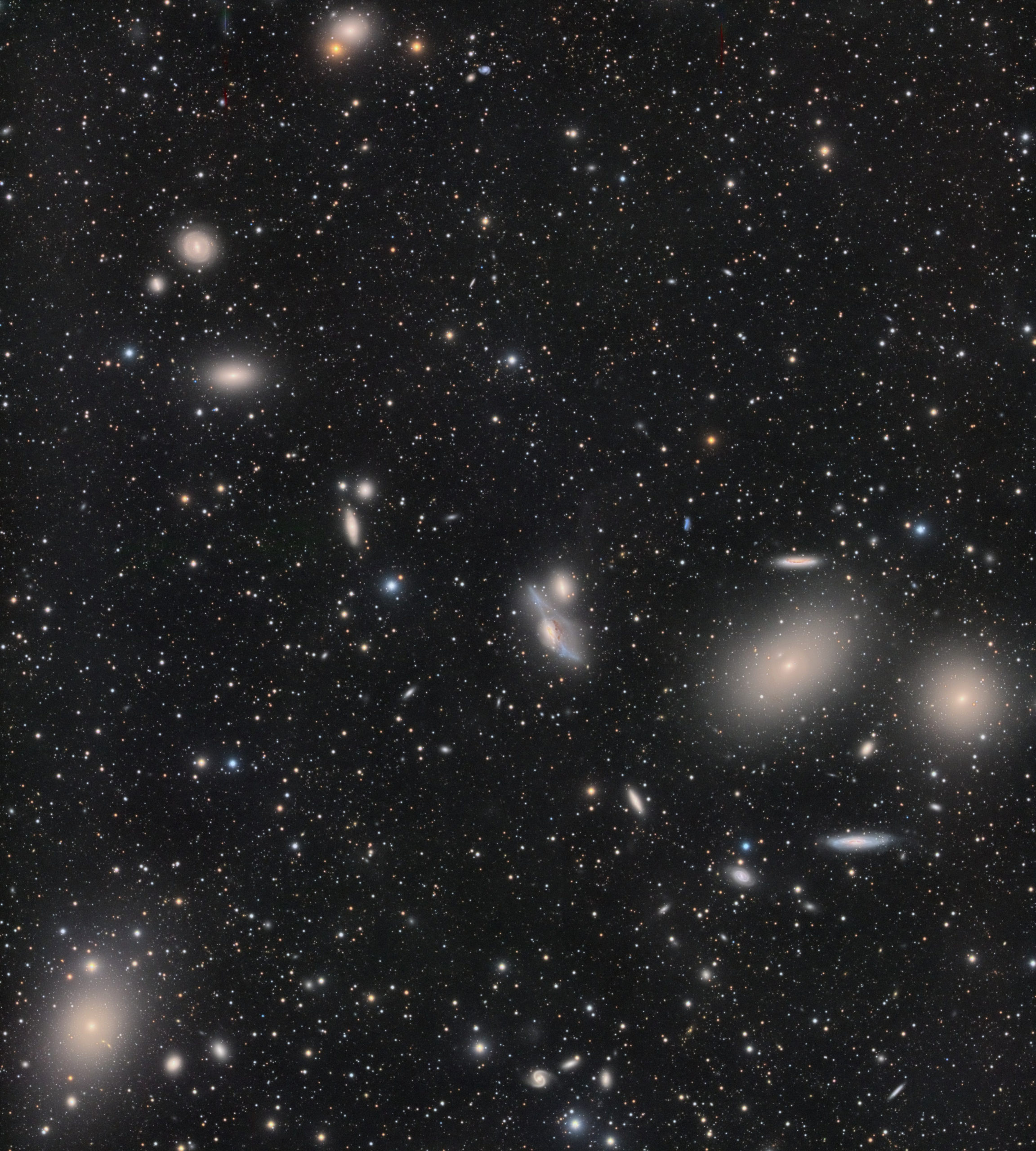
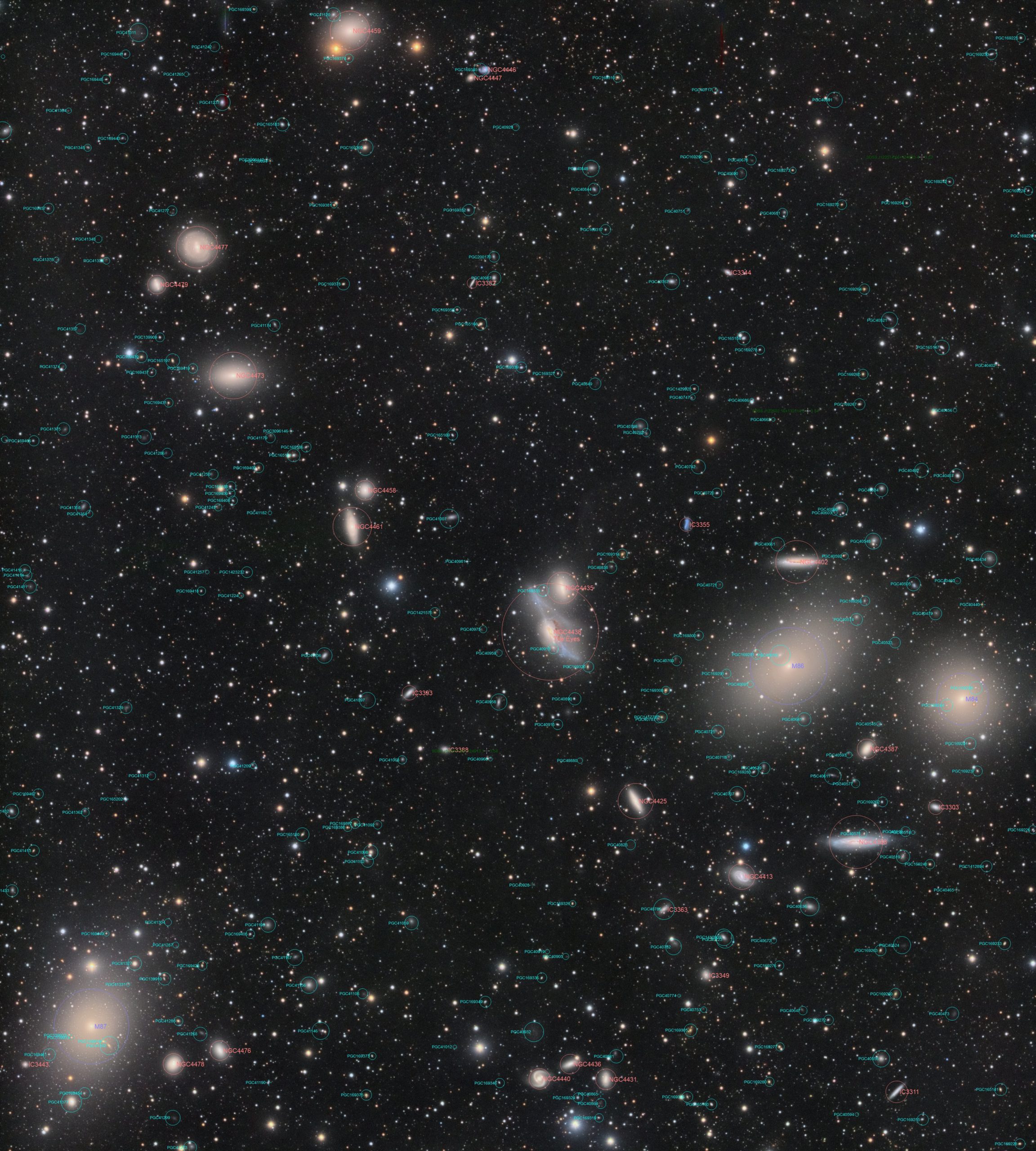
The faintest star in this image has an apparent magnitude of 22.6 magv (SDSS DR15).
The three highest redshift quasars [Flesh 2015] in the image are:
SDSS J122602.10+132114.5 z=3.53 magG=18.2 (Gaia DR2)
SDSS J122811.68+124913.1 z=3.54 magG=20.7 (Gaia DR2)
SDSS J122514.66+134523.4 z=3.52 magG=20.3 (Gaia DR2)
The images were taken with the following equipment:
- Date: 2018
- Location: Rowe, New Mexico
- Telescope: Astrophysics RH305
- Focal length [mm]: 1159
- Focal ratio: 3.8
- Mount: Paramount ME
- Camera: SBIG STX-16803
- Filter: L:R:G:B
- Exposure time [min]: 180:230:180:220
- Resolution: 1.66″/px
For the 2010 data the data calibration and registration was performed in DeepSkyStacker and the final processing was done with PixInsight. The result was as follows:
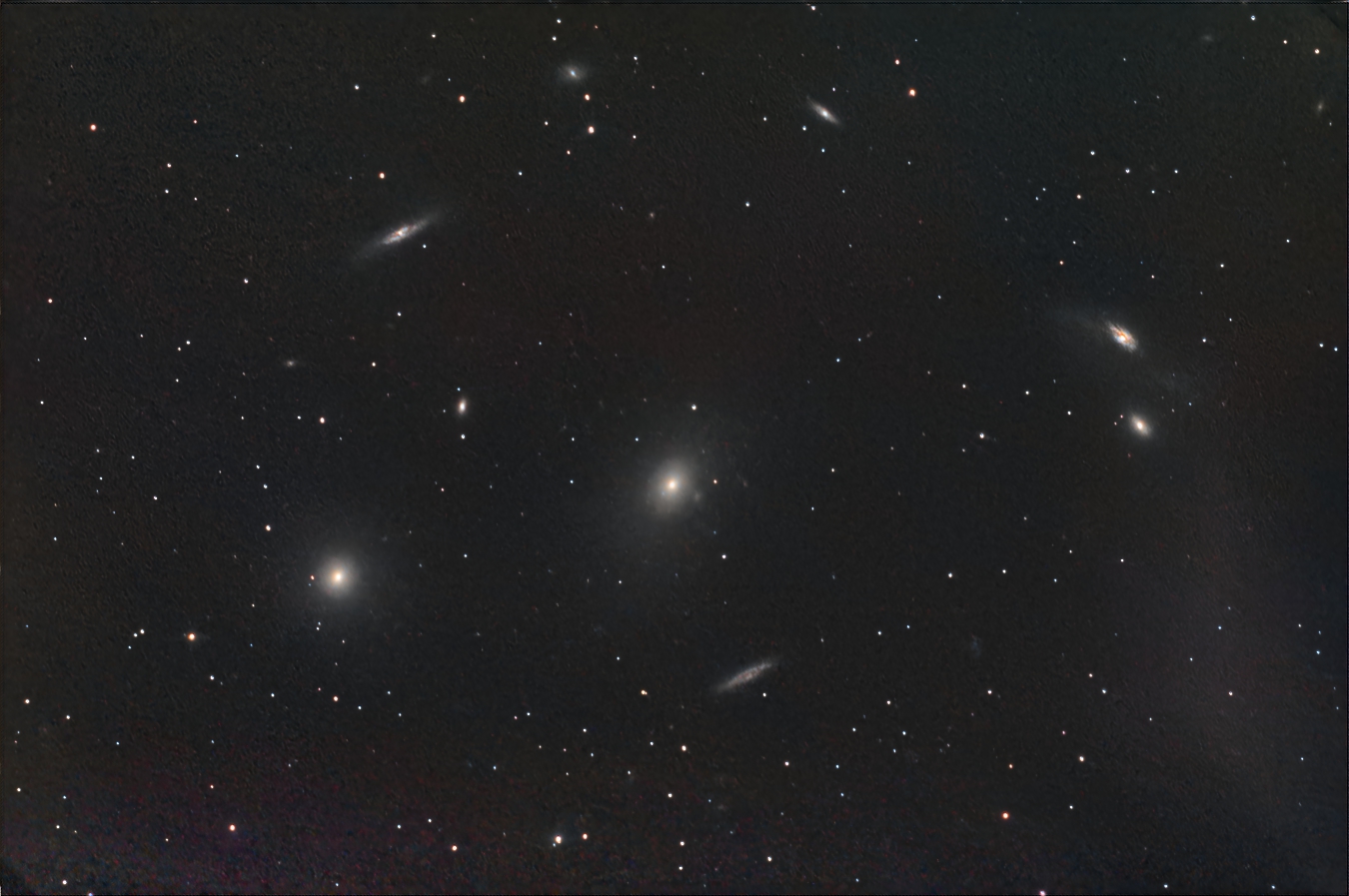
The images were taken with the following equipment:
- Date: 2010
- Location: Krefeld, Germanyy
- Telescope: 8″ GSO Newton
- Focal length [mm]: 800
- Focal ratio: 4
- Mount: Skywatcher NEQ6
- Camera: Canon 300Da
- Filter: no
- Exposure time [min]: 173
- Resolution: 2.93″/px

Leave a reply