

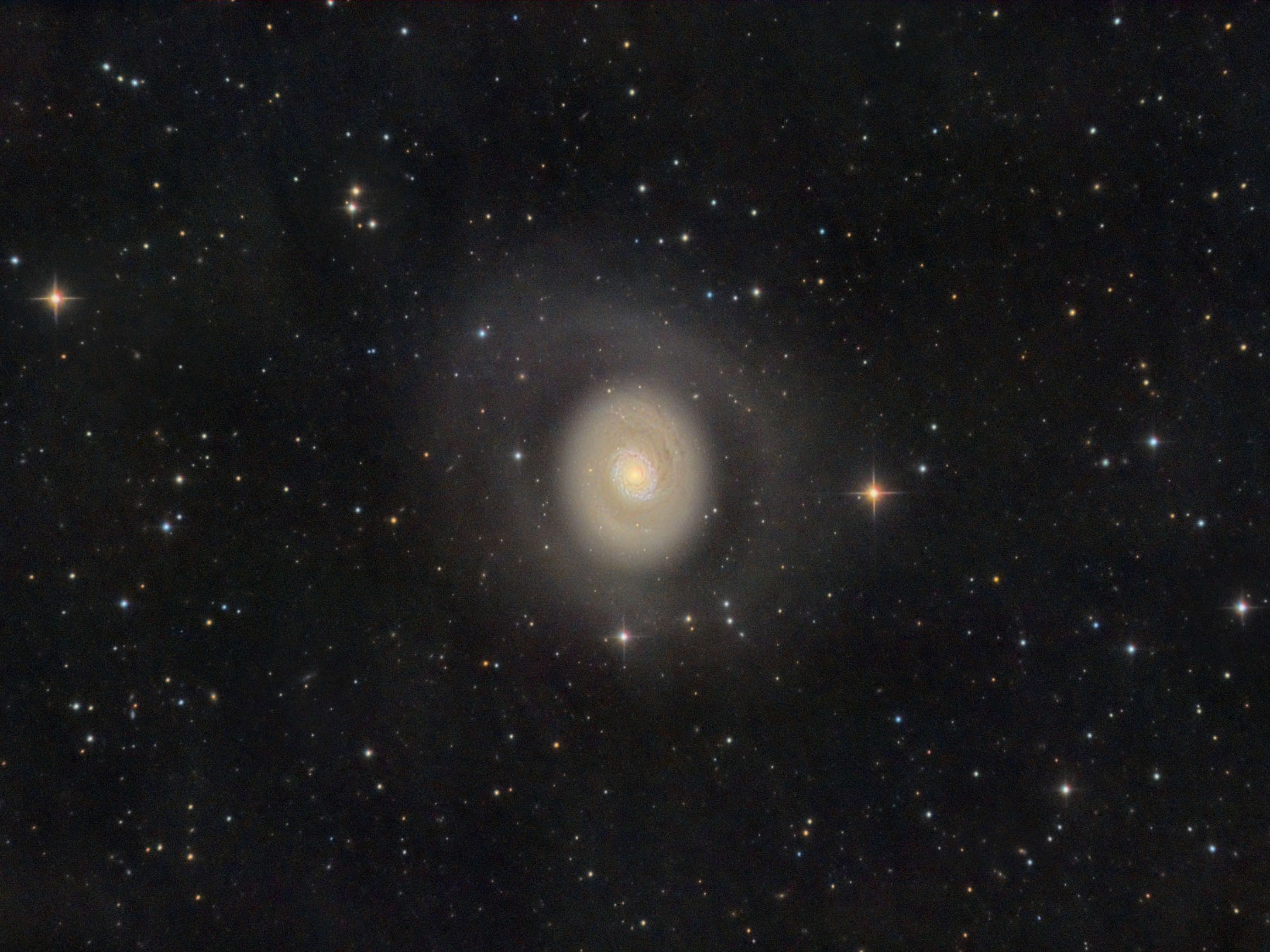
Messier 94 from my backyard, own „Sterntaucher“ observatory and remote
In 2010 I imaged Messier 94 from my backyard using my DSLR camera. Later that same year, I obtained an additional dataset through the LightBuckets remote observatory, captured with a CCD camera under pristine, dark skies. By combining both datasets, I produced my first composite image of this galaxy, taking advantage of the deeper, cleaner CCD signal to complement the DSLR data.
A decade later, in 2020, I revisited M94 with my dual-rig setup. This time, I recorded high-resolution luminance data using a 10″ Newtonian reflector, while a small APO refractor simultaneously captured the RGB channels. After calibration and integration, both datasets were carefully aligned and the color data was upscaled to match the luminance resolution, resulting in a significantly more detailed LRGB image.
Messier 94, located in the constellation Canes Venatici, is one of the most intriguing nearby spiral galaxies. Classified as (R)SA(r)ab, it is famous for its prominent inner ring of star formation and its extended, faint outer disk—often referred to as an “outer ring” or “XUV disk.” This extended structure is exceptionally challenging to capture and benefits greatly from long total integration times and clean, well-calibrated data. The combination of backyard and remote observations, followed years later by the dual-rig LRGB project, highlights both the galaxy’s complex morphology and how much imaging quality can evolve with improved equipment and techniques.
Data calibration and registration and the final processing was done with PixInsight. The result was as follows:
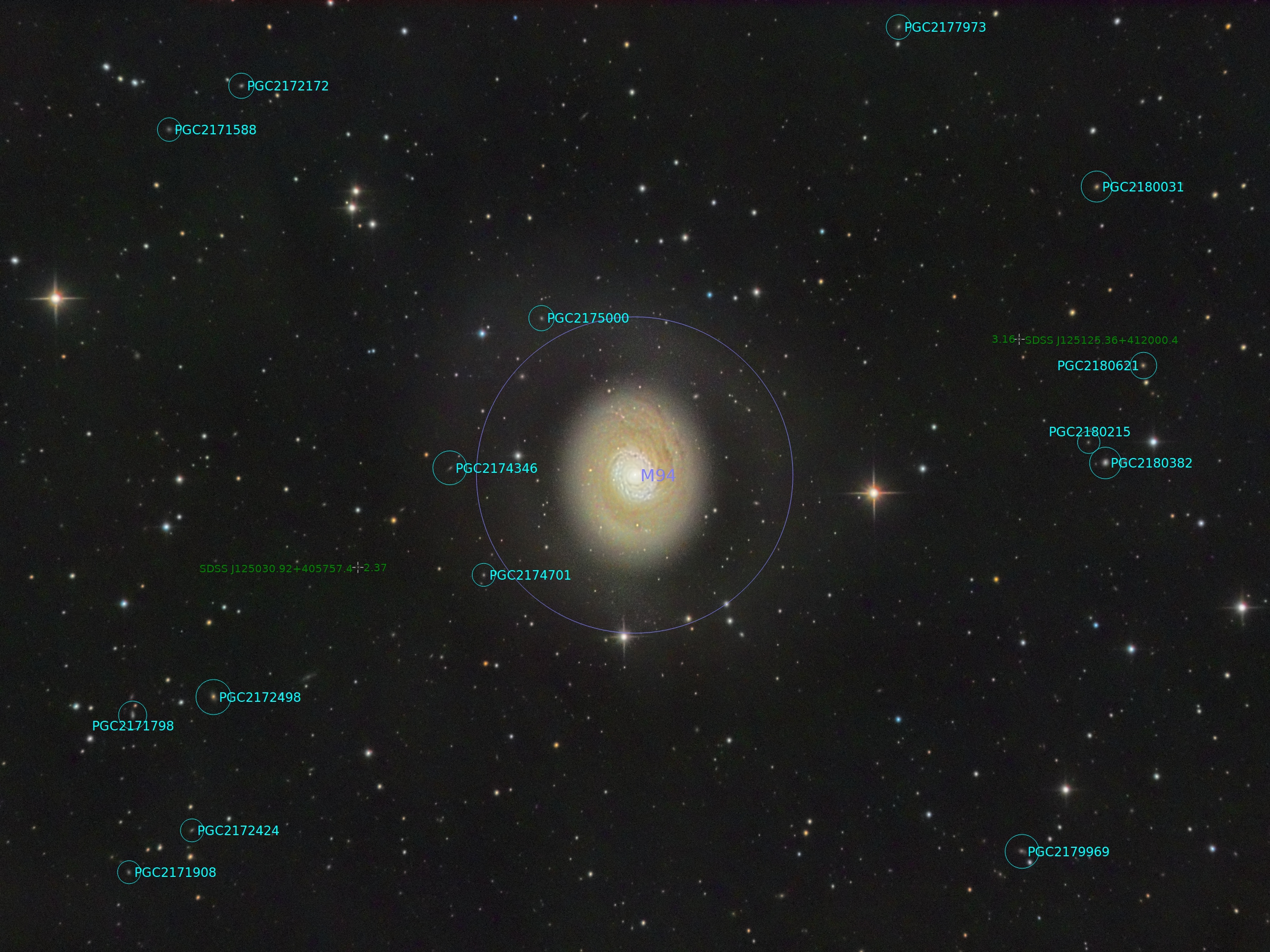
The faintest star in my image has an apparent magnitude of 21.4 magG (SDSS DR15).
The two highest redshift quasars [Flesh 2015] in the image are:
SDSS J125125.36+412000.4 z=3.15 magG=18.9 (Gaia DR2)
SDSS J125030.92+405757.4 z=2.37 magG=19.2 (Gaia DR2)
Here is an overview of the used equipment and the exposure times:
- Date: March 2020
- Location: Krefeld, Germany
- Telescope/Lens: 10″ Newton ohne Namen / TSQ-65ED Apo
- Focal length [mm]: 1000 / 420
- Focal ratio: 3.9 / 6.5
- Mount: Skywatcher EQ8
- Camera: Moravian G2 8300 FW / Moravian G3 16200 FW
- Autoguiding: DMK21 AU04 on TSQ-65ED
- Filter: CLS / R:G:B
- Exposure time [min]: 422 / 190:180:180
- Resolution: 1.11″/px / 2.95″/px
For the 2010 data the data calibration and registration was performed with DeepSkyStacker, the final processing was done with PixInsight. The result was as follows:

Here is an overview of the used equipment and the exposure times:
- Date: Spring 2010
- Location: Krefeld, Germany / Rodeo, New Mexico
- Telescope/Lens: 8″ GSO Newton / 8″ ASA Astrograph
- Focal length [mm]: 800 / 720
- Focal ratio: 4 / 3.6
- Mount: Skywatcher NEQ6 / ASA DDM 85
- Camera: Canon 300Da / Apogee Alta U8300
- Filter: no / L:R:G:B
- Exposure time [min]: 187 / 28:24:24:24
- Resolution: 2.09″/px / 1.5″/px




Leave a reply