

Leo triplet (Messier 65, 66 and NGC 3628)
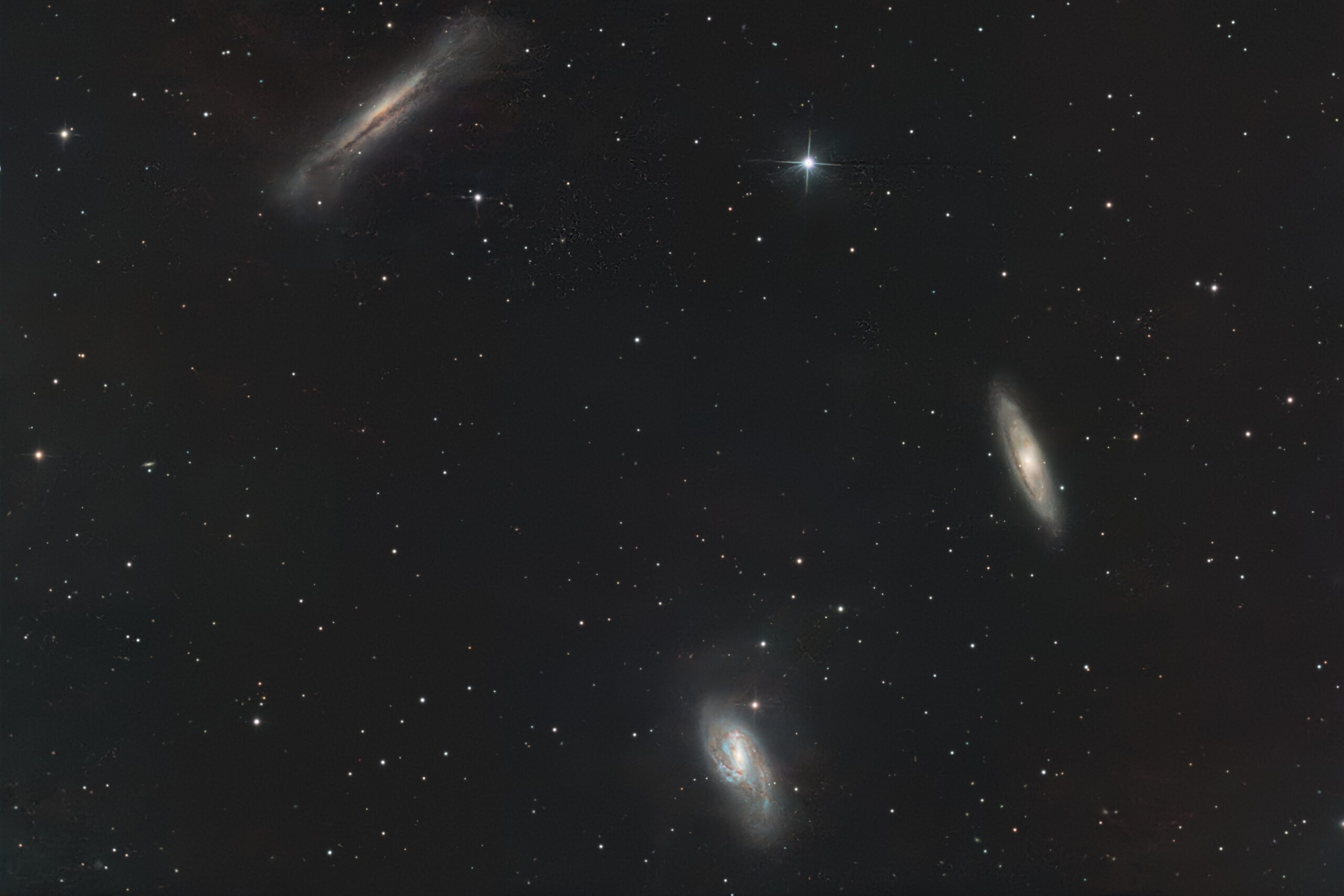
I have been subscribing to data from the Deep Sky West (DSW) Observatory for several years. Located in New Mexico, DSW operates multiple fully equipped imaging systems capable of capturing exceptionally deep and stable data. In 2018, I received a dataset of the Leo Triplet, a fascinating group of gravitationally interacting galaxies situated in the constellation Leo.
Before working with the remote DSW dataset, I had imaged the Leo Triplet from my own backyard using DSLR equipment in 2008 and 2010. These early attempts captured the basic forms of the galaxies, but the DSW data reached far deeper—revealing fine dust structures, faint halos, tidal distortions, and low-surface-brightness features that were well beyond the capabilities of my earlier DSLR images.
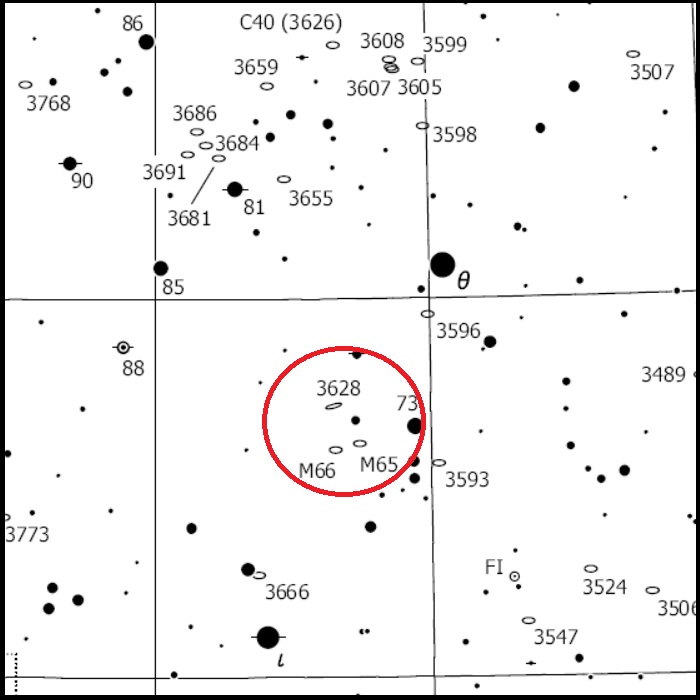
The Leo Triplet consists of three prominent spiral galaxies: Messier 65 (M65), Messier 66 (M66), and NGC 3628, all located approximately 35 million light-years away. Although they share a similar distance and region of the sky, each galaxy exhibits distinct structural characteristics shaped in part by their mutual gravitational interactions.
M65 is a relatively undisturbed SAB(rs)a) spiral galaxy, showing tightly wound arms and a bright central bulge dominated by an older stellar population. M66, classified as SAB(s)b), reveals stronger signs of tidal influence—its spiral arms appear asymmetric, and its dust lanes are more irregular, likely the result of past close encounters with its neighbors. NGC 3628, the third member of the group, is an edge-on spiral galaxy famous for its broad, dark dust lane and an extended tidal tail stretching nearly 300,000 light-years into intergalactic space. This tail is one of the clearest indicators of the gravitational interaction shaping the trio.
Data calibration and registration and the final processing was done with PixInsight. The result was as follows:
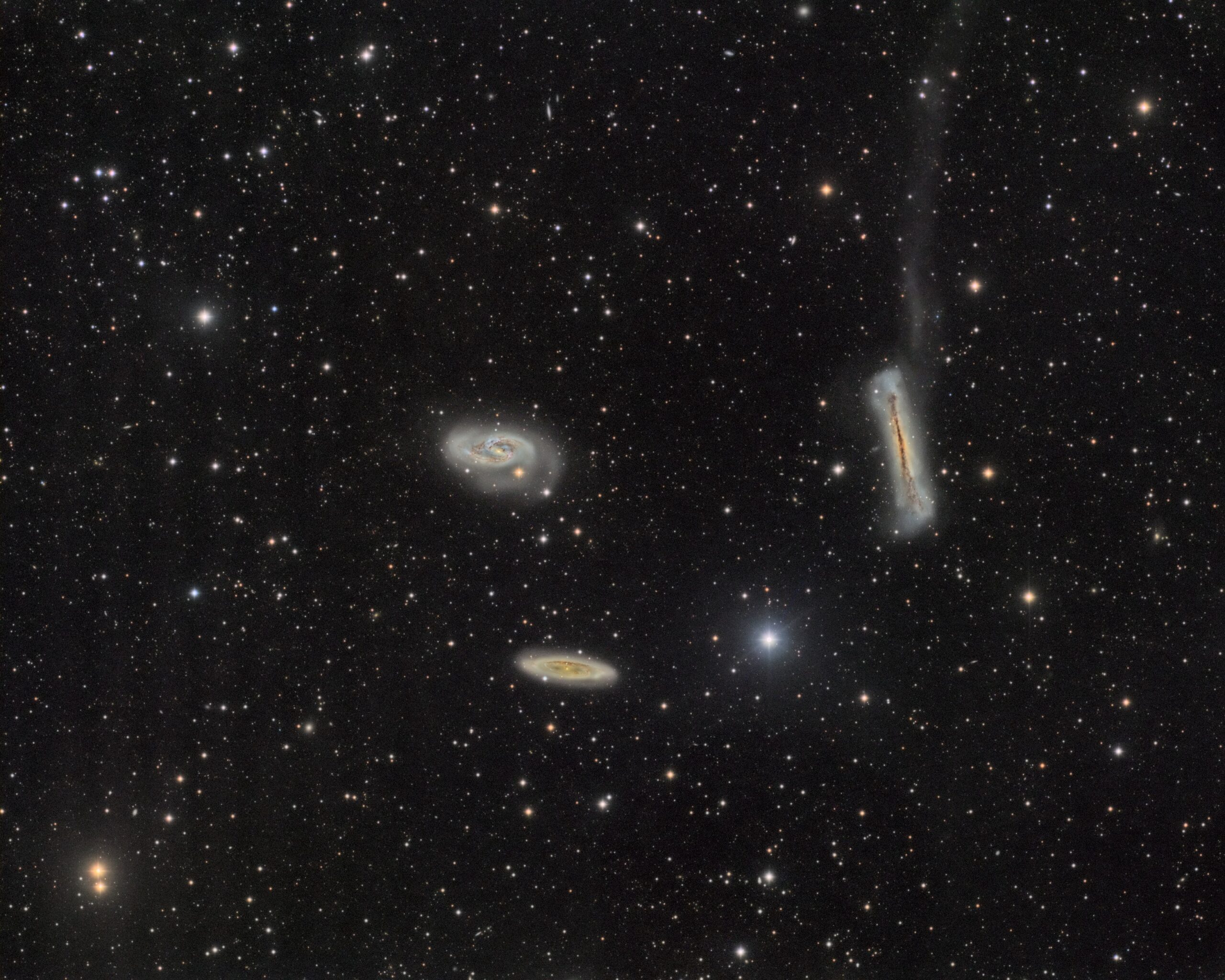
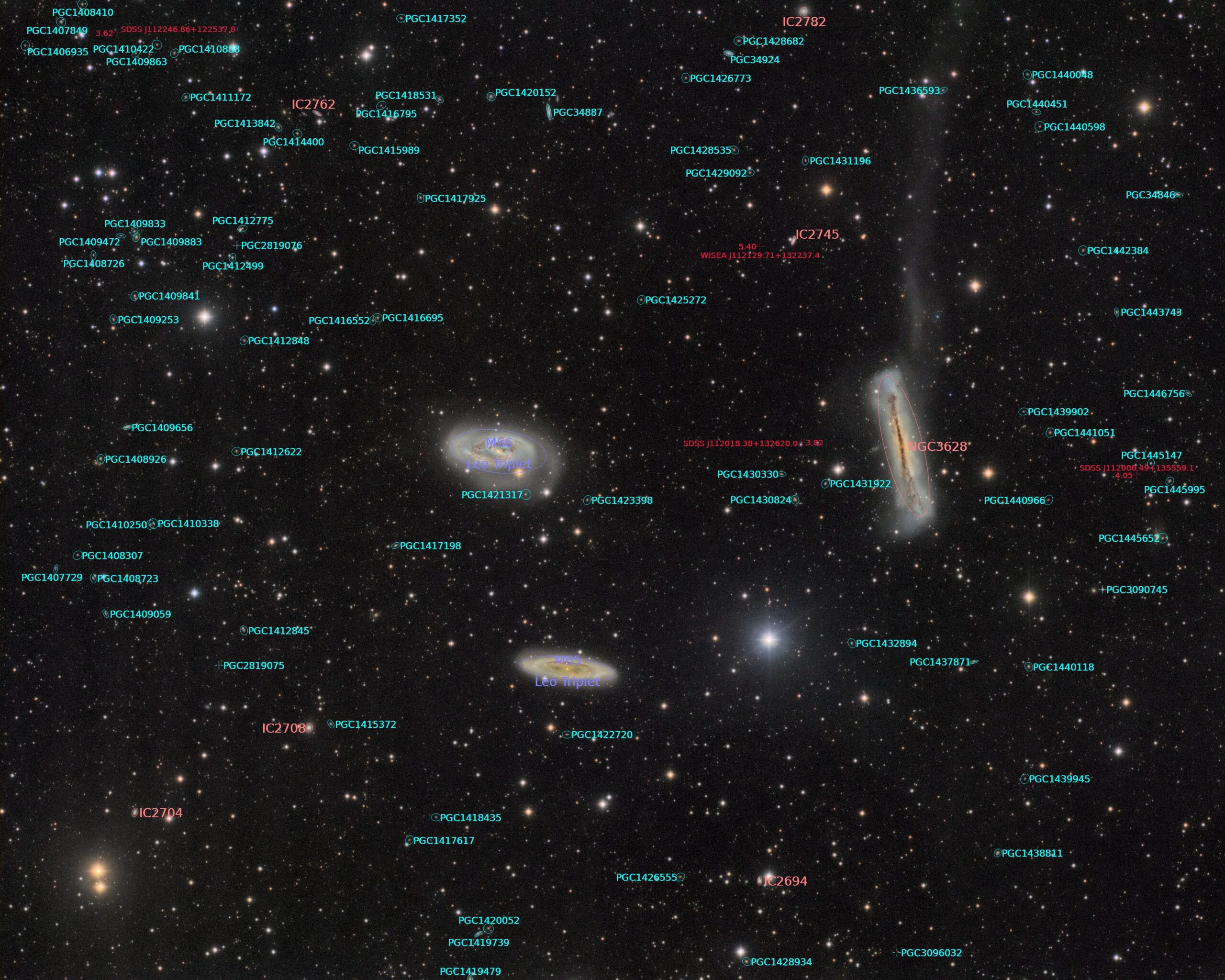
The faintest star in this image has an apparent magnitude of 22.6 magG (DSSR 15).
The highest redshift quasars [Flesh 2015] in the image are:
- WISEA J112129.71+132237.4 z=5.40
- SDSS J112006.49+135559.1 z=4.05
- SDSS J112018.38+132620.0 z=3.82
- SDSS J112246.86+122537.8 z=3.62
There are also a lot of asteroids in the image:
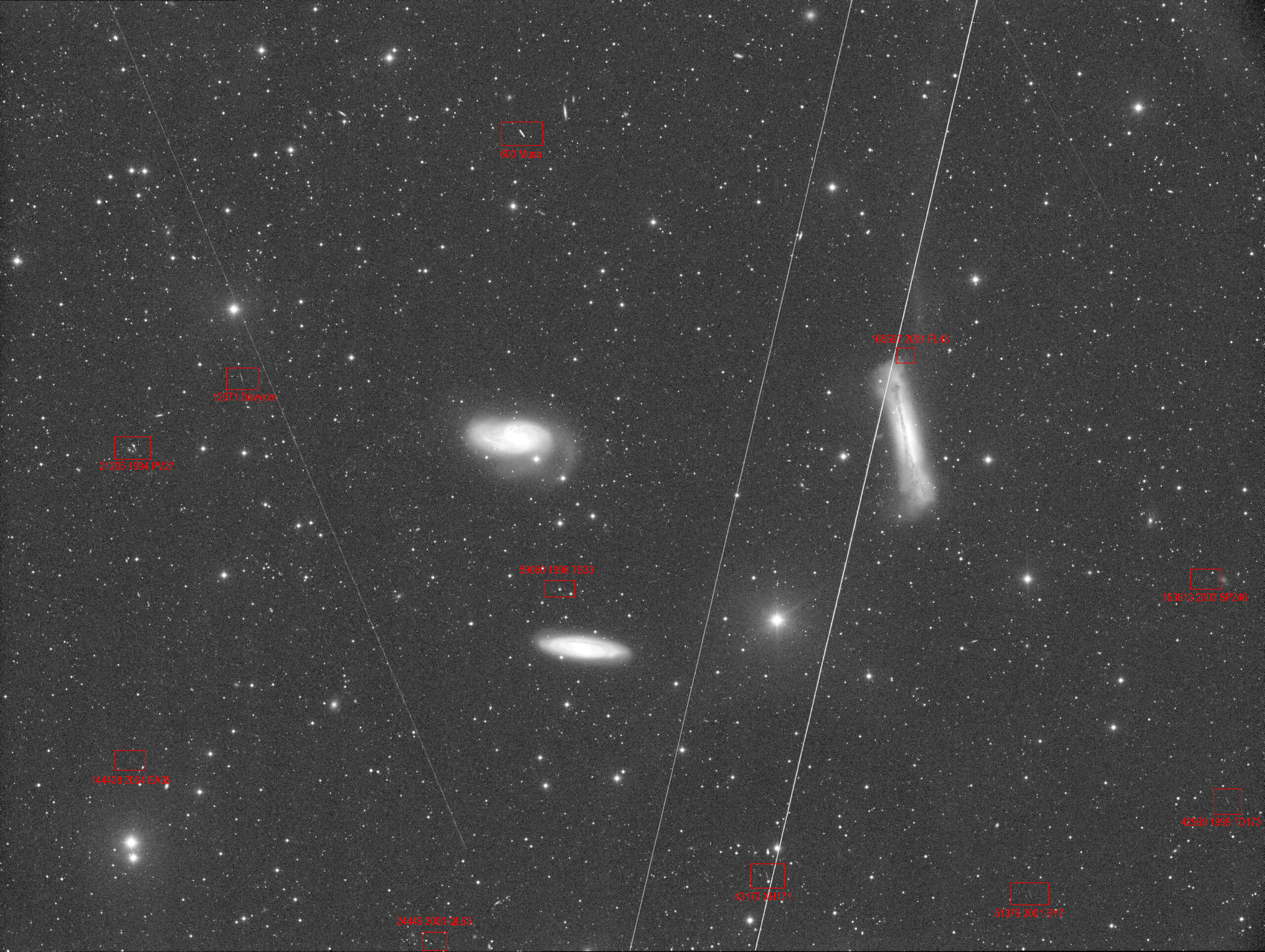
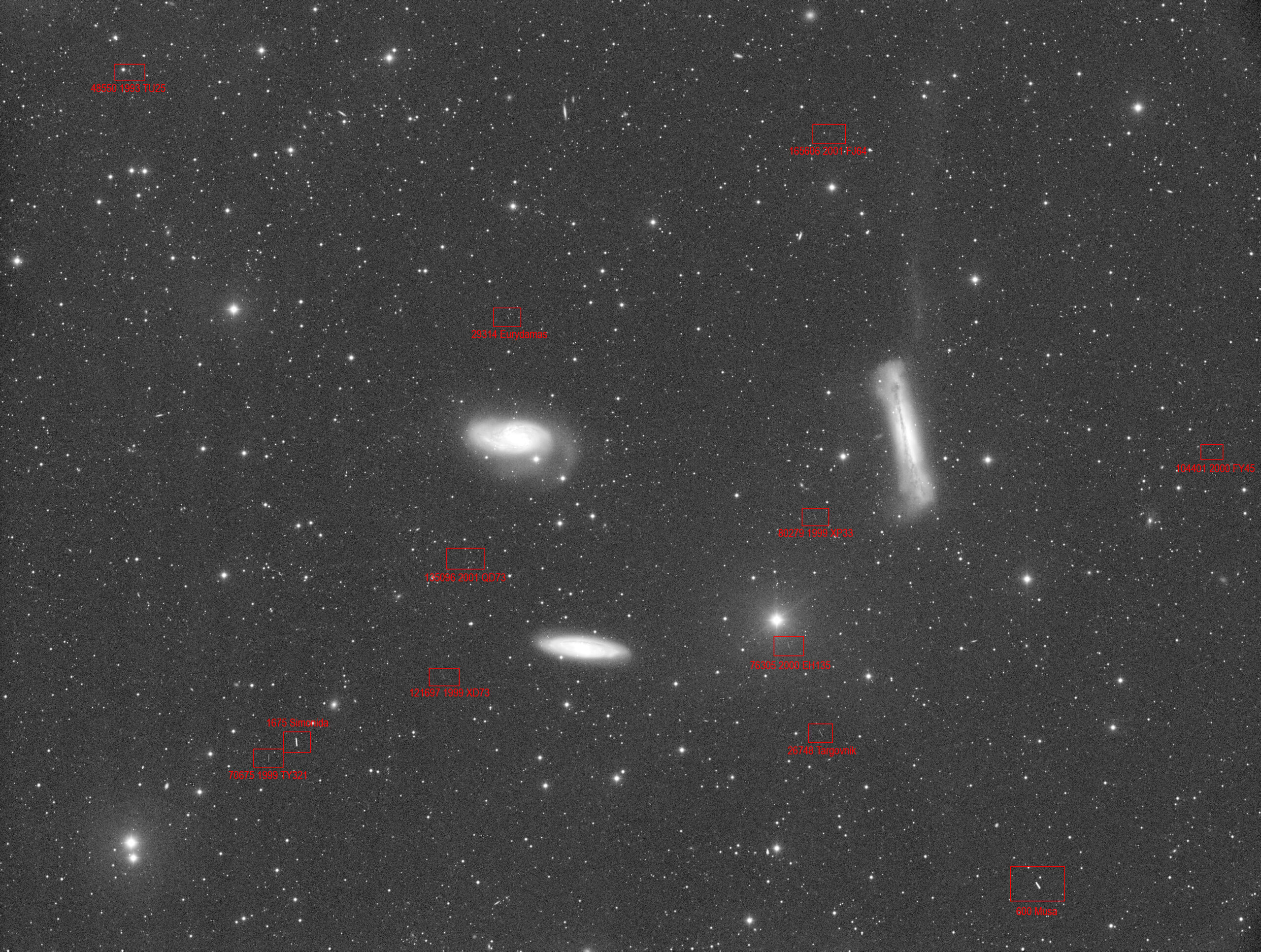
The images were taken with the following equipment:
- Date: 2018
- Location: Rowe, New Mexico
- Telescope/Lens: Takahashi FSQ-106
- Focal length [mm]: 530
- Focal ratio: 5
- Mount: Paramount MyT
- Camera: QSI 683-WSG-8
- Filter: L:R:G:B
- Exposure time [min]: 615:540:555:450
- Resolution: 2.08″/px
This is the image from 2010:
The images were taken with the following equipment:
- Date: 2010
- Location: Krefeld, Germany
- Telescope/Lens: 8″ GSO Newton
- Focal length [mm]: 800
- Focal ratio: 4
- Mount: Skywatcher NEQ6
- Camera: Canon 500Da
- Filter: OSC
- Exposure time [min]: 179
- Resolution: 1,25″/px
This is the image from 2008:

The images were taken with the following equipment:
- Date: 2008
- Location: Krefeld, Germany
- Telescope/Lens: Pentax 75
- Focal length [mm]: 500
- Focal ratio: 6.7
- Mount: Vixen GP-DX
- Camera: Canon 300Da
- Filter: OSC
- Exposure time [min]: 15
- Resolution: 3.04″/px



Leave a reply