

Messier 92 (NGC 6341)
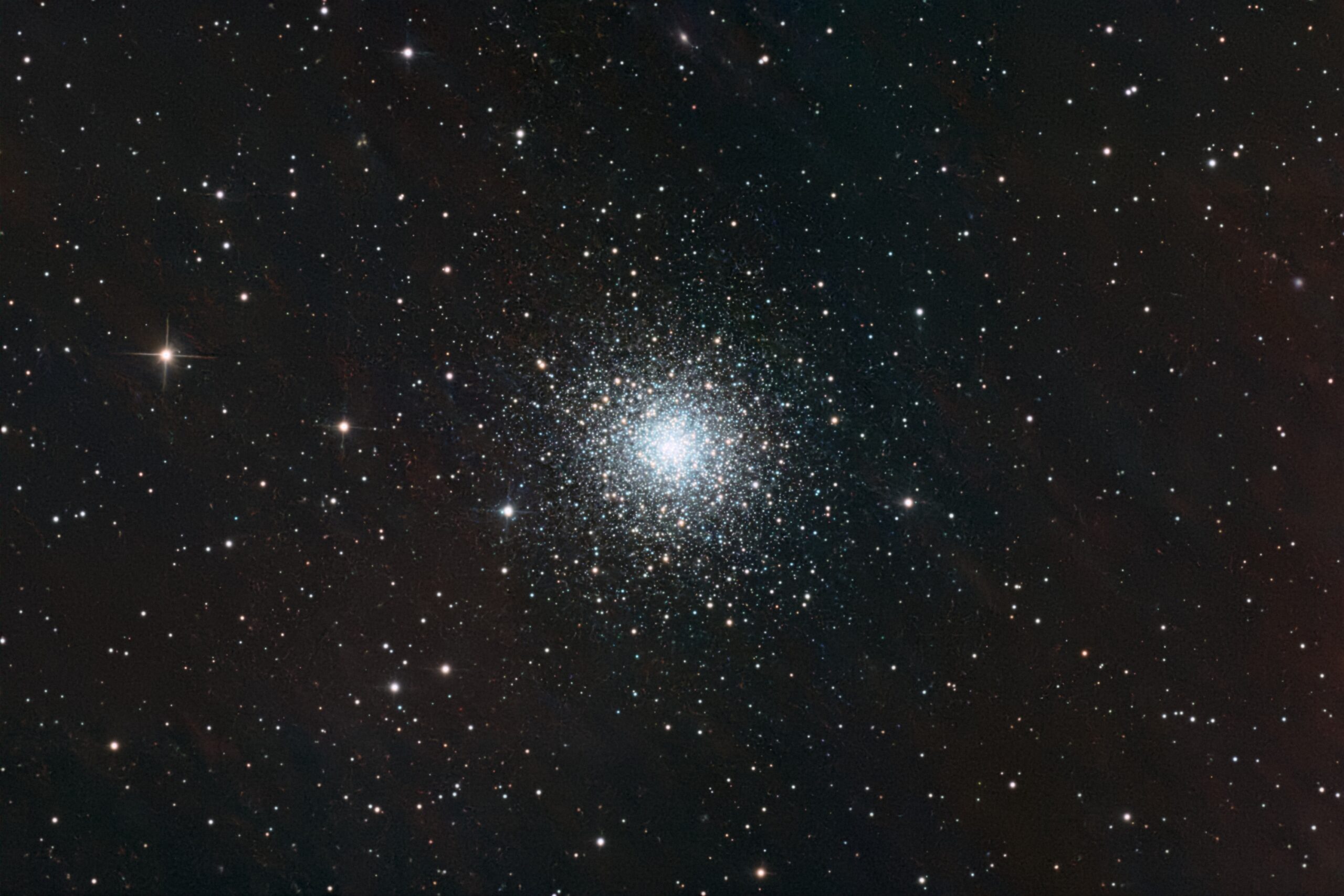
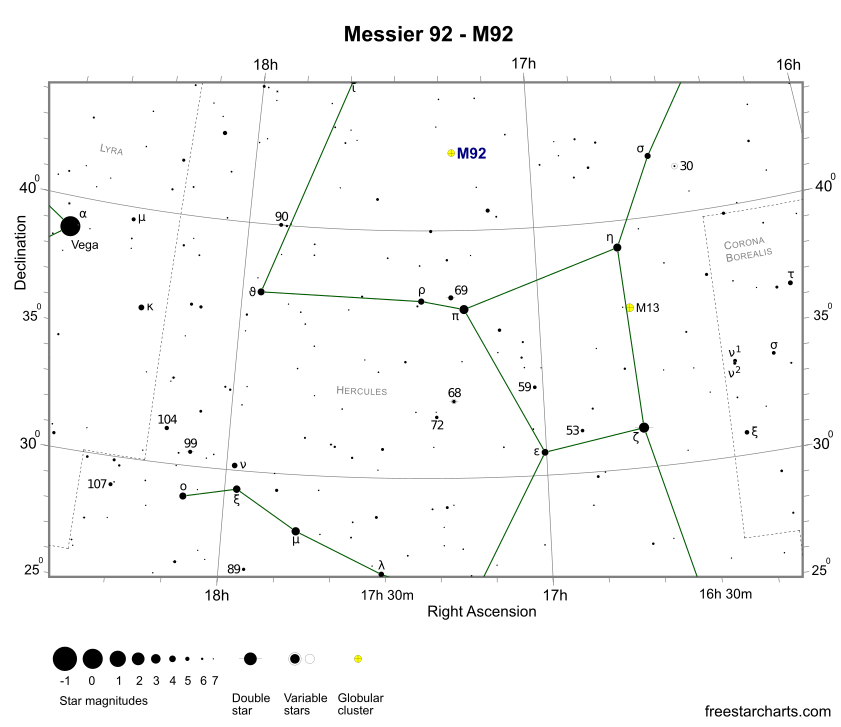
I have been subscribing to data from the Deep Sky West (DSW) Observatory for several years. Located in the high desert of New Mexico, DSW offers exceptionally stable seeing and a suite of fully equipped remote systems—conditions that are ideal for high-quality deep-sky imaging. One of the data sets I received in 2019 was of the globular cluster Messier 92, situated in the constellation Hercules. Before working with this professional-grade dataset, I had imaged M92 twice from my backyard: first in 2005 with my very first setup, and again in 2010 with the same equipment but more experience and longer total integration time, leading to a noticeable improvement in image depth and quality.
Scientifically, M92 is one of the oldest, most metal-poor, and most dynamically evolved globular clusters in the Milky Way. Located roughly 27,000 light-years away, it is often overshadowed by its brighter neighbour M13, yet it ranks among the most pristine stellar populations known. With a metallicity around [Fe/H] ≈ –2.3, M92 contains stars that formed in the early epochs of the Galaxy’s history, making it an important benchmark for studying stellar evolution in extremely low-metallicity environments.
Its dense core, high central concentration, and well-populated blue horizontal branch offer valuable insight into cluster dynamics, mass segregation, and the late evolutionary stages of old stars. Deep imaging also brings out the extended halo of low-surface-brightness stars surrounding the cluster—a subtle structure that reveals the effects of long-term tidal interactions with the Milky Way.
Working with the DSW dataset allowed me to capture the fine granularity of M92’s stellar population with far greater clarity than was possible from my backyard, showcasing both its dense, sparkling core and its scientifically fascinating role as one of the Galaxy’s most ancient stellar fossils.
Data calibration and registration and the final processing was done with PixInsight. The result was as follows:


The faintest star in this image has an apparent magnitude of 21.5 magG (DSSR 15).
The three highest redshift quasars [Flesh 2015] in the image are:
SDSS J171822.76+423945.2 z=2.90 magG=21.2
VPM J17160+4330 2=2.90 magG=19.8
VPM J17197+4309 z=3.20 magG=19.2
For the 2010 data the data calibration and registration was performed in DeepSkyStacker, the final processing was done with PixInsight. The result was as follows:
The images were taken with the following equipment:
- Date: 2010
- Location: Krefeld, Germany
- Telescope/Lens: 8″ GSO Newton
- Focal length [mm]: 800
- Focal ratio: 4
- Mount: Skywatcher NEQ6
- Camera: Canon 300Da
- Filter: no
- Exposure time [min]: 180
- Resolution: 0.94″/px (Drizzle 2)
For the 2005 data the data calibration and registration was performed in DeepSkyStacker, the final processing was done with PixInsight. The result was as follows:

The images were taken with the following equipment:
- Date: 2005
- Location: Krefeld, Germany
- Telescope/Lens: 8″ GSO Newton
- Focal length [mm]: 800
- Focal ratio: 4
- Mount: Vixen GP-DX
- Camera: Canon 300Da
- Filter: no
- Exposure time [min]: 6
- Resolution: 0.94″/px (Drizzle 2)


Leave a reply