

NGC 40 from my backyard
In 2010 and 2011 I imaged the planetary nebula NGC 40 twice from my backyard in Krefeld, using the same DSLR setup for both sessions. By combining the two datasets, I was able to improve the signal-to-noise ratio and reveal the fine structures in this compact nebula more clearly than either dataset alone could provide.
Scientifically, NGC 40—often called the Bow-Tie Nebula—is a classic example of a low-excitation planetary nebula in Cepheus, located roughly 3,000 light-years away. At its center lies a Wolf–Rayet-type central star (HD 826), one of the hottest known central stars of any planetary nebula, with an estimated temperature of about 90,000 K.
Its intense stellar wind interacts with previously ejected material, producing the characteristic filamentary shell and the soft outer halo that can be captured with longer exposures. The nebula’s complex morphology, including its asymmetric density structures and faint external envelope, makes NGC 40 a rewarding target even under suburban skies—especially when multiple imaging sessions are combined into a single, deeper result.
The data calibration and registration were carried out using DeepSkyStacker, while the final image processing was completed in PixInsight
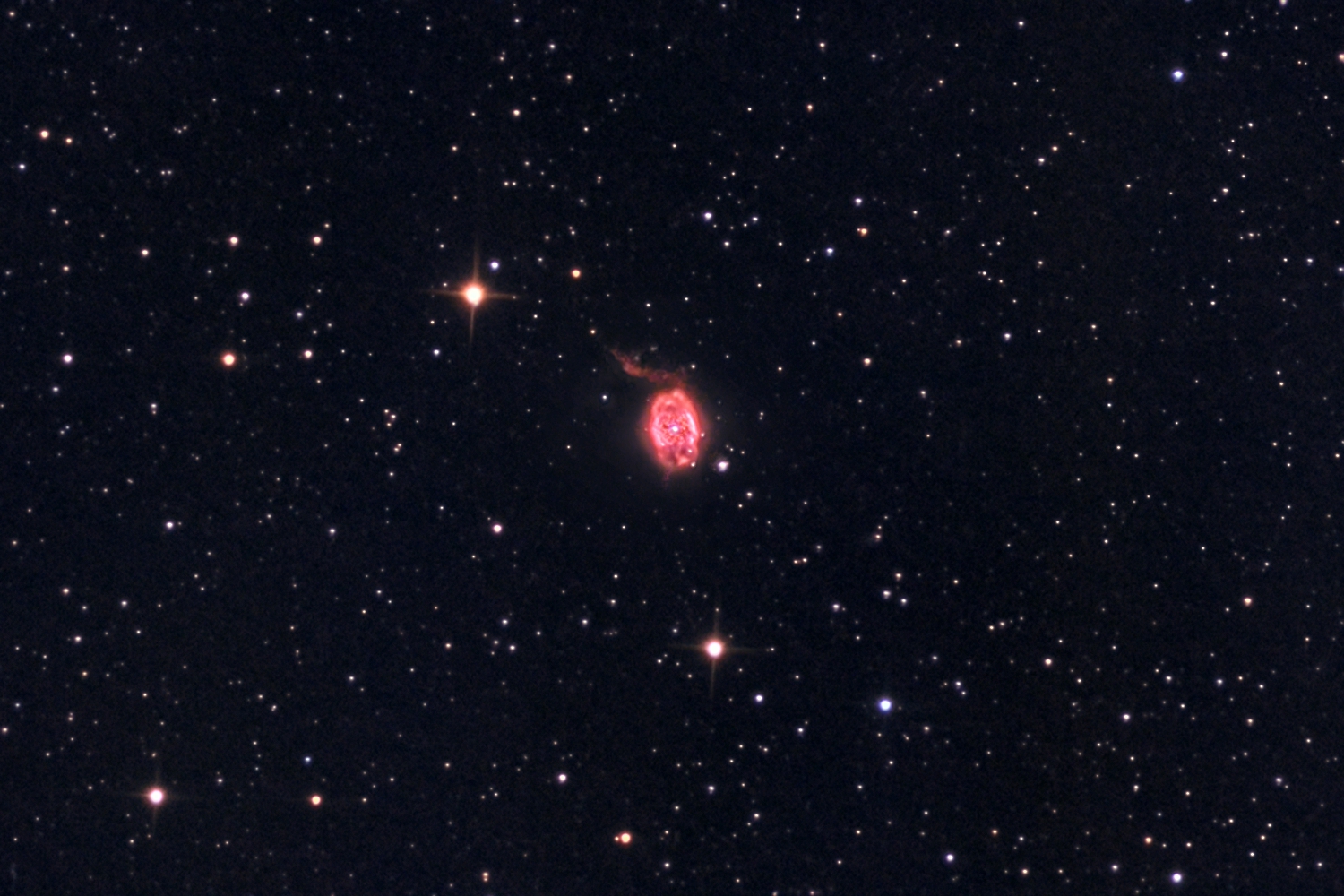
The images were taken with the following equipment:
- Date: 2010, 2011
- Location: Krefeld, Germany
- Telescope: 10″ Orion Newton
- Focal length [mm]: 1200
- Focal ratio: 4.8
- Mount: Skywatcher NEQ6
- Camera: Canon 500Da
- Filter: no
- Exposure time [min]: 370
- Resolution: 0.85″/px




Leave a reply